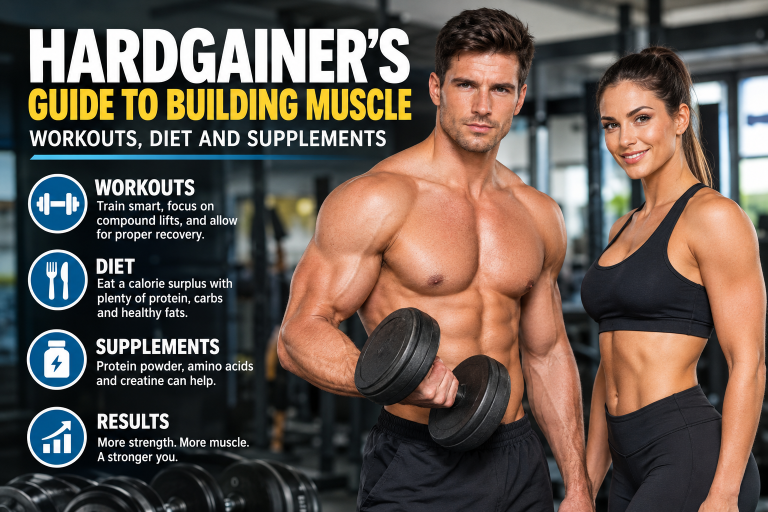
Are you struggling to gain weight and put on muscle even though you train hard and feel like you eat a lot? You may consider yourself a hardgainer.
Building muscle can be especially frustrating when the scale refuses to move. You may spend hours in the gym, eat large meals, and still find that gaining a few pounds seems almost impossible. The good news is that the solution usually isn’t simply working harder. It is creating a more consistent system for training, eating, recovery, and progression.
This comprehensive hardgainer muscle-building guide explains how to structure your workouts, how many calories and meals to eat, which supplements may help, and which common approaches can actually make gaining muscle more difficult.
What Is a Hardgainer in Bodybuilding?
A hardgainer is a person who has difficulty gaining body weight and muscle mass despite resistance training and what they believe is a high-calorie diet.
The term is commonly associated with naturally lean people who have difficulty maintaining a calorie surplus. Some hardgainers may have high daily activity levels, low appetite, inconsistent calorie intake, or simply underestimate how many calories they need to gain weight.
It is also common for hardgainers to describe themselves as having an ectomorph body type. While body-type classifications can be useful as general descriptions, they don’t determine your ability to build muscle. Your results ultimately depend much more on factors such as calorie intake, protein intake, progressive resistance training, recovery, genetics, and consistency.
The biggest challenge for a hardgainer is often surprisingly simple: consistently eating enough calories to support weight gain.
The Basic Formula for Building Muscle as a Hardgainer
If you have difficulty gaining weight, you need to make gaining weight a deliberate process rather than hoping it happens naturally.
A successful hardgainer strategy should include:
- A consistent calorie surplus
- Adequate daily protein
- Heavy compound resistance exercises
- Progressive overload
- Enough training recovery
- 7–9 hours of quality sleep
- Consistent tracking and adjustment
You don’t need to destroy your muscles with marathon workouts. In fact, excessive training combined with insufficient calories can make it even harder to recover and gain mass.
Hardgainer Workout Routine
A hardgainer workout routine should emphasize quality over quantity. Rather than training six days a week, many people who struggle to gain weight can benefit from a lower-frequency program that provides plenty of recovery between workouts.
A practical starting point is two or three full-body workouts a week. For example, you could train Monday, Wednesday, and Friday, or Monday and Thursday.
The objective isn’t to perform dozens of exercises. Instead, concentrate on a relatively small number of productive compound movements and work on getting stronger over time.
Example 3-Day Hardgainer Workout
Monday
- Squat – 3 sets of 5–8 reps
- Bench Press – 3 sets of 5–8 reps
- Barbell Row – 3 sets of 6–10 reps
- Romanian Deadlift – 2 sets of 6–10 reps
Wednesday
- Deadlift – 2–3 sets of 4–6 reps
- Overhead Press – 3 sets of 5–8 reps
- Pull-Ups or Lat Pulldowns – 3 sets of 6–10 reps
- Leg Press – 2 sets of 8–12 reps
Friday
- Squat – 3 sets of 5–8 reps
- Incline Bench Press – 3 sets of 6–10 reps
- Seated Cable Row – 3 sets of 6–10 reps
- Leg Curl – 2 sets of 8–12 reps
This is only an example. Exercises can be changed based on your equipment, experience, injury history, and individual needs.
Why Hardgainers Should Focus on Compound Exercises
Compound exercises train multiple muscle groups simultaneously. Squats, deadlifts, presses, rows, and pull-ups allow you to train a large amount of muscle without requiring an enormous number of exercises.
For someone who struggles to gain weight, this can be particularly useful because your training doesn’t need to consume your entire week.
The goal should be to stimulate muscle growth and then give your body the resources and recovery time necessary to adapt.
Progressive Overload Is Essential
Simply going to the gym isn’t enough. Your body needs a reason to adapt.
Progressive overload means gradually increasing the training stimulus over time. This can involve adding weight, performing additional repetitions, improving technique, or increasing training volume when appropriate.
For example, if you can perform 8 clean repetitions with a particular weight this week, you might work toward 9 or 10 repetitions before increasing the weight.
Keep a workout log. Recording your exercises, weights, repetitions, and sets makes it much easier to determine whether you are actually progressing.
Don’t Confuse More Training With More Muscle
One of the most common mistakes made by hardgainers is believing that more training must produce more muscle.
Muscle growth occurs as your body adapts to training. If you continually add workouts without allowing sufficient recovery, you can accumulate fatigue without getting better results.
That’s why a hardgainer program should leave room for rest, food, and sleep.
Hardgainer Diet Plan
For many hardgainers, nutrition is the biggest piece of the puzzle.
If your body weight isn’t increasing, you’re probably not consistently consuming enough calories to produce weight gain—even if your meals seem large.
A reasonable starting point is to consume approximately 300–500 calories above your estimated maintenance intake and monitor your weight over several weeks.
If your average body weight isn’t increasing, gradually increase your calorie intake.
Eat More Frequently If Necessary
Some people simply don’t have a large appetite. Trying to consume enormous meals three times a day can become uncomfortable.
Instead, divide your food into 5–6 meals or eating opportunities throughout the day.
Smaller, calorie-dense meals can make it easier to consistently reach your daily calorie target.
Choose Calorie-Dense Foods
Hardgainers don’t need to live on junk food just because they need more calories. Focus on nutritious foods that provide plenty of calories, protein, carbohydrates, and healthy fats.
Good choices include:
- Lean beef
- Chicken and turkey
- Eggs
- Fish
- Rice
- Oatmeal
- Potatoes and sweet potatoes
- Whole-grain bread
- Greek yogurt
- Milk or other suitable dairy alternatives
- Nuts and nut butters
- Avocado
- Olive oil
- Fruit and dried fruit
Protein for Hardgainers
Protein provides the amino acids your body needs to repair and build muscle tissue.
A practical target for people who regularly perform resistance training is approximately 1.6–2.2 grams of protein per kilogram of body weight a day.
Spread your protein intake across several meals rather than trying to consume nearly all of it in one sitting.
Don’t Forget Carbohydrates
Carbohydrates are particularly useful for hardgainers because they provide an efficient source of training fuel and can make it easier to consume enough total calories.
Rice, potatoes, oats, pasta, fruit, bread, and other high carbohydrate foods can form an important part of a muscle-building diet.
There is no need to fear carbohydrates when your goal is gaining muscle. Your overall calorie intake and diet quality matter far more than eliminating an individual macronutrient.
Healthy Fats Make Eating More Calories Easier
Dietary fat contains more calories per gram than protein or carbohydrates, making it an easy way to increase the energy density of your meals.
Add foods such as nuts, nut butter, avocado, olive oil, seeds, and other nutritious sources of fat to meals when you need additional calories.
Example Hardgainer Meal Plan
Here’s an example of how a hardgainer could structure a day of eating:
Breakfast
- Oatmeal with milk
- Banana
- Peanut butter
- Eggs
Mid-Morning Meal
- Greek yogurt
- Fruit
- Nuts
Lunch
- Chicken or lean beef
- Rice
- Vegetables
- Olive oil or avocado
Pre- or Post-Workout Meal
- Protein shake
- Oats or fruit
- Nut butter
Dinner
- Lean beef, chicken, fish, or another protein source
- Potatoes, rice, or pasta
- Vegetables
Before Bed
- Greek yogurt or cottage cheese
- Fruit
- Nuts or nut butter
This is an example rather than a prescription. Adjust portions and food choices according to your calorie needs, preferences, and dietary requirements.
Hardgainer Supplements
Supplements should support a good diet and training program rather than replace them. For hardgainers, a few supplements can be particularly convenient.
1. Protein Powder
Protein powder is one of the simplest ways to increase your daily protein intake without having to prepare another complete meal.
A protein shake can be especially useful after training or between meals when you’re having difficulty reaching your daily protein target.
2. Amino Acids
Amino acids are the building blocks of protein. Getting enough complete protein throughout the day should be the foundation, but an amino acid supplement can provide a convenient way to supplement your nutritional routine.
For hardgainers, amino acids should be viewed as an addition to adequate protein and calorie intake—not a substitute for either one.
3. Creatine
Creatine is one of the most extensively studied sports supplements and can help improve high-intensity exercise performance and support increases in strength and lean body mass when combined with resistance training.
A common maintenance dose is 3–5 grams a day. Consistency is more important than taking it at a particular time of day.
Supplements Hardgainers Should Avoid
High-Calorie, Low-Quality Mass Gainers
Some commercial mass gainers contain very large amounts of calories, often from highly processed carbohydrate sources. While they can make consuming enough calories easier, they shouldn’t be an excuse to build your diet around low-quality foods.
If you need additional calories, consider making your own calorie-dense shake using protein powder, oats, fruit, milk or a suitable alternative, and nut butter.
Pre-Workout Stimulants
Hardgainers should be cautious about relying heavily on stimulant-based pre-workout products.
Large amounts of caffeine can reduce appetite in some people and may interfere with sleep. Since adequate food intake and recovery are critical for gaining muscle, anything that consistently disrupts either one can work against your goal.
You don’t need a powerful stimulant to have a productive workout.
Fat Burners
Fat burners are designed around the opposite goal of what most hardgainers are trying to accomplish.
If you’re struggling to gain weight, your priority should generally be providing your body with enough calories and nutrients to support training and recovery—not trying to increase calorie expenditure.
Sleep and Recovery for Hardgainers
Training provides the stimulus, but recovery gives your body the chance to adapt.
Aim for approximately 7–9 hours of sleep per night. Consistent sleep can support recovery, training performance, appetite regulation, and overall health.
Rest days are also important. You don’t have to train every day to build an impressive physique.
How Fast Should a Hardgainer Gain Weight?
Don’t make the mistake of trying to gain as much weight as possible as quickly as possible.
Rapid weight gain can result in unnecessary increases in body fat. Instead, aim for a gradual increase in body weight and adjust your calories based on your progress.
Weigh yourself several times a week under similar conditions and look at your weekly average rather than becoming concerned about individual daily fluctuations.
If your average weight hasn’t increased after a couple of weeks of consistent eating, add more calories. If you’re gaining weight much faster than intended, reduce your calorie surplus somewhat.
Common Hardgainer Mistakes
1. Assuming You Eat More Than You Actually Do
This is one of the most common problems. People often remember the large meals they ate while forgetting the days when they skipped meals or didn’t finish them.
Track your food for at least a couple of weeks if you’re having trouble gaining weight.
2. Changing Workouts Constantly
Muscle growth requires progressive training. Constantly changing exercises makes it difficult to determine whether you’re actually getting stronger.
3. Doing Too Much Cardio
Cardiovascular exercise can be beneficial for health and fitness, but excessive cardio can make it more difficult to maintain the calorie surplus needed for weight gain.
Keep cardio appropriate for your goals and make sure you compensate for additional activity with adequate food intake.
4. Training Every Day
More gym time isn’t automatically better. Hardgainers should pay close attention to recovery and avoid unnecessary training volume.
5. Not Tracking Progress
If you don’t measure your body weight, strength, food intake, and training performance, you’re largely guessing.
Keep a simple record and make small adjustments when your progress stalls.
How to Break Through a Hardgainer Plateau
If you’ve been following a muscle-building program but your progress has stopped, don’t immediately add another hour to your workout.
Instead, examine the fundamentals:
- Are you consistently eating in a calorie surplus?
- Are you consuming enough protein?
- Are your lifts improving?
- Are you getting enough sleep?
- Are you taking sufficient rest days?
- Has your body weight actually stopped increasing?
If your weight has remained unchanged for several weeks, increase your calorie intake. If your weight is increasing but your strength isn’t improving, review your training and recovery.
Most plateaus don’t require a radically different program. They often require better consistency with the fundamentals.
The Hardgainer Muscle-Building Formula
If you’re naturally lean and struggle to gain weight, remember that building muscle isn’t about finding a magic supplement or performing an endless number of exercises.
The basic formula is straightforward:
Calorie surplus + adequate protein + progressive resistance training + recovery + consistency = muscle-building progress.
Train hard, but don’t train needlessly. Eat enough calories every day. Get plenty of protein and nutritious carbohydrates and fats. Sleep enough. Track your progress and make adjustments when necessary.
Final Thoughts on Building Muscle as a Hardgainer
Being a hardgainer can make building muscle more challenging, but it doesn’t mean you are incapable of gaining significant strength and size.
The key is to stop relying on guesswork and create a structured plan.
Train two or three times a week with an emphasis on productive compound movements. Consume a consistent calorie surplus with plenty of protein and nutrient-dense foods. Eat more frequently if that makes reaching your calorie target easier. Use supplements such as protein powder and creatine when they provide a practical benefit, rather than expecting supplements to compensate for an inadequate diet.
Most importantly, be patient. Building a muscular physique takes time. If you consistently provide your body with the training stimulus, calories, nutrients, and recovery it needs, you give yourself the best possible chance to turn a hardgainer physique into a stronger, more muscular body.
Frequently Asked Questions About Hardgainers
What is the best workout for a hardgainer?
A full-body resistance-training routine performed two or three times a week can be an effective starting point. Focus on compound exercises, progressive overload, moderate training volume, and adequate recovery.
How many calories should a hardgainer eat?
Start with a modest calorie surplus, such as approximately 300–500 calories above estimated maintenance, and monitor your weight. If your average weight doesn’t increase over several weeks, gradually increase your calorie intake.
How many meals should a hardgainer eat?
There is no magic number of meals for muscle growth. However, eating five or six smaller meals can make it easier for people with low appetites to consume enough calories throughout the day.
What supplements are best for hardgainers?
Protein powder can help you reach your protein target, while creatine monohydrate can support strength and high-intensity training performance. Amino acid supplements can also be used as part of a broader nutrition strategy. Supplements should complement—not replace—a calorie- and protein-adequate diet.
Should hardgainers use mass gainers?
A mass gainer can be convenient if you have difficulty consuming enough calories, but it isn’t necessary. A homemade shake containing protein powder, oats, fruit, milk or a suitable alternative, and nut butter can provide a calorie-dense alternative.
Should hardgainers train every day?
No. Training every day isn’t necessary for muscle growth. A two- or three-day full-body program can provide a productive training stimulus while leaving plenty of time for recovery.
Shop Truly Huge Bodybuilding Supplements
Email support@trulyhugebodybuilding.com or call (800) 635-8970 with any questions you have and we’ll be happy to help you find the best supplements to help you reach your bodybuilding and fitness goals.