
When you first start bodybuilding, making progress can seem relatively simple. Train consistently, progressively increase the demands placed on your muscles, eat enough protein, recover properly, and your physique can change dramatically.
But advanced bodybuilding is different.
After years of training, the easy gains are gone. Progress becomes slower, plateaus become more common, and small details involving training intensity, exercise selection, nutrition, recovery and supplementation can make a much bigger difference.
For the advanced bodybuilder, the goal isn’t simply to put more weight on the bar every workout. It’s about creating enough of the right training stimulus to continue encouraging muscle growth while managing fatigue and recovery.
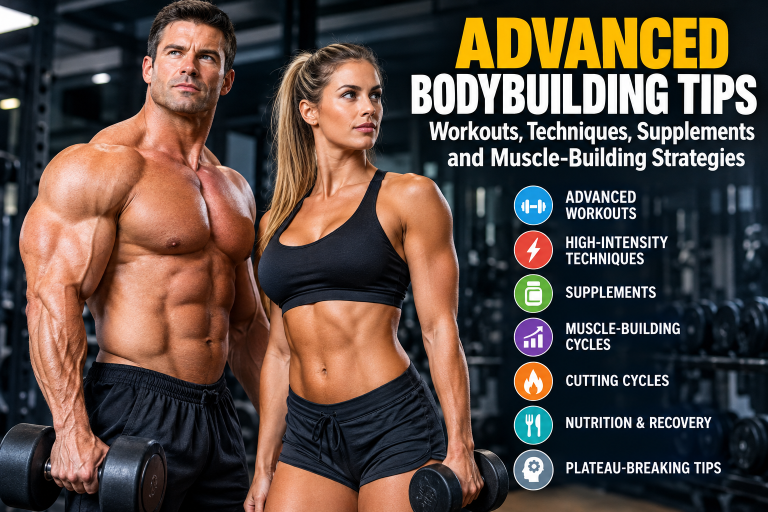
This guide covers advanced bodybuilding tips, advanced workouts, high-intensity training techniques, supplementation, muscle-building phases and cutting strategies.
What Makes Advanced Bodybuilding Different?
Advanced lifters have already developed a substantial amount of muscle and have accumulated years of training experience. As a result, the rate of muscle growth naturally becomes slower.
That means advanced bodybuilding requires greater attention to:
- Progressive overload
- Training intensity
- Exercise selection
- Training volume
- Training frequency
- Recovery
- Protein and calorie intake
- Body composition
- Periodization
- Fatigue management
The objective is not to make every workout harder simply for the sake of making it harder. The objective is to provide a productive stimulus that you can recover from and repeat consistently.
Advanced Bodybuilding Workouts
Advanced bodybuilding workouts often incorporate higher-intensity techniques, specialized split routines and periodization. These strategies can help experienced lifters continue progressing when conventional workouts are no longer producing the same results.
Use Progressive Overload
Progressive overload remains one of the foundations of advanced bodybuilding. However, progression does not always mean adding weight.
An advanced lifter can progress by:
- Increasing repetitions with the same weight
- Increasing resistance while maintaining good form
- Improving exercise technique
- Increasing range of motion
- Improving control of the eccentric portion of an exercise
- Increasing training density
- Adding carefully planned training volume
Keeping a detailed training log can make it much easier to identify whether you are actually progressing.
Advanced Bodybuilding Split Routines
Advanced bodybuilders often use split routines that allow them to concentrate training on specific muscle groups while providing adequate recovery between sessions.
Examples include:
- Push, pull, legs
- Upper body and lower body
- Chest and back
- Shoulders and arms
- Legs
- Specialization routines for lagging body parts
There is no single advanced bodybuilding split that is automatically superior for everyone. The best routine is one that provides an effective training stimulus while allowing you to recover and progressively improve.
Advanced Bodybuilding Techniques
Advanced bodybuilding techniques are high-intensity training methods that experienced lifters can use when standard progressive-overload training begins producing slower results.
These techniques can increase training stress without simply adding more exercises to a workout.
1. Supersets
A superset involves performing two exercises consecutively with little or no rest between them.
One approach is to train opposing muscle groups, such as chest and back. Another is to perform two exercises for the same muscle group.
Supersets can increase training density and create a significant pump while potentially reducing the amount of time required for a workout.
2. Pre-Exhaust Training
Pre-exhaust training involves performing an isolation exercise before a compound movement.
For example, an advanced lifter might perform leg extensions before squats or dumbbell flyes before a chest pressing movement.
The purpose is to fatigue the target muscle before the compound exercise so that the muscle becomes a limiting factor during the subsequent movement.
3. Rest-Pause Training
Rest-pause training involves performing a challenging set, taking a short rest period and then completing additional repetitions with the same weight.
This can allow an experienced lifter to accumulate additional high-quality repetitions without performing another traditional full set.
Because rest-pause training can be highly demanding, it should be used strategically rather than on every exercise.
4. Drop Sets
A drop set involves performing a set close to muscular fatigue and then immediately reducing the weight and continuing with additional repetitions.
Drop sets can be particularly useful for increasing training intensity at the end of a workout.
They are best used selectively because repeatedly taking multiple exercises to extreme fatigue can interfere with recovery.
5. Negatives
Negative training emphasizes the eccentric, or lowering, portion of an exercise.
The eccentric phase can be performed under controlled conditions to increase the challenge placed on the target muscle.
Advanced negative training can be very demanding, so recovery needs to be considered when incorporating it into a program.
6. Cluster Sets
Cluster sets divide a traditional set into smaller groups of repetitions separated by short rest periods.
For example, instead of performing eight repetitions continuously, a lifter might perform several smaller groups with brief pauses between them.
Cluster sets can allow advanced lifters to maintain higher-quality repetitions and manage fatigue during demanding exercises.
Don’t Use Every Advanced Technique at Once
One of the biggest mistakes advanced lifters can make is assuming that more intensity is always better.
Combining supersets, drop sets, rest-pause sets, negatives and extremely high training volume in the same workout can create a tremendous amount of fatigue without necessarily producing additional muscle growth.
Advanced training should be precise rather than chaotic.
Use an advanced technique because it serves a specific purpose in your program—not simply because it makes the workout more painful.
Advanced Bodybuilding Periodization
Periodization involves strategically changing training variables over time instead of attempting to train at maximum intensity indefinitely.
An advanced program might include periods emphasizing:
- Strength
- Hypertrophy
- Training volume
- Higher training intensity
- Recovery and fatigue reduction
Planned changes can help prevent stagnation and allow you to manage accumulated fatigue.
Advanced Bodybuilding Supplements
Advanced bodybuilding supplementation involves combining supplements that complement your training, nutrition and recovery strategy.
Supplements should support a solid bodybuilding program rather than replace proper training, nutrition and sleep.
Protein Powder
Protein powder provides a convenient way to help meet your daily protein requirements, particularly when obtaining enough protein from whole foods becomes difficult.
Whey, milk, egg and other protein powders can be incorporated around workouts or at other convenient times during the day.
Amino Acids
Amino acids are the building blocks of proteins and play important roles in muscle protein metabolism.
Advanced bodybuilders may use amino acid supplements as a convenient addition to a high-protein diet, particularly around training.
Creatine
Creatine is one of the most extensively studied sports supplements and can support high-intensity exercise performance and strength.
Kre-Alkalyn is the most widely recommended form of creatine to take for best results with minimum side effects. Consistent daily use is generally more important than trying to time every dose around a workout.
Testosterone Support Supplements
Testosterone boosters typically contain combinations of herbs, minerals or other ingredients intended to support normal testosterone production or related processes.
It is important to distinguish these products from anabolic steroids or prescription hormone therapy. Supplement effects can vary considerably depending on the ingredients, dosage and individual.
HGH Support Supplements
HGH support products are generally formulated to support factors associated with the body’s natural growth hormone environment rather than supplying human growth horrmone itself.
Sleep, exercise, nutrition and recovery remain fundamental factors when the goal is to optimize the body’s normal hormonal environment.
Ecdysterone
Ecdysterone is a naturally occurring compound in the ecdysteroid family that has attracted interest among athletes and bodybuilders.
It is commonly used in bodybuilding supplementation with the goal of supporting muscle growth, strength and body composition.
As with any supplement, advanced lifters should evaluate the available evidence, product quality, dosage and individual response rather than assuming that a supplement will produce dramatic results.
Advanced Bodybuilding Muscle-Building Cycle
An advanced natural muscle-building phase combines progressive resistance training, sufficient recovery and a calorie surplus designed to provide the energy required for growth.
The basic structure can include:
- Progressive overload
- High-intensity training techniques used strategically
- Appropriate training frequency
- A high-protein diet
- A controlled calorie surplus
- Adequate carbohydrates to support training
- Healthy dietary fats
- Consistent sleep and recovery
- A carefully selected supplement stack
The objective is to gain muscle while limiting unnecessary fat accumulation.
Extreme Mass Stack
For bodybuilders looking to supplement a muscle-building phase, Truly Huge Supplements offers the Extreme Mass Stack, combining Andro Shock Testosterone Booster, Pumped Extreme Kre-Alkalyn Creatine and Nitrobol Amino Acid Complex.
The concept behind the stack is to combine products targeting different aspects of a muscle-building program, including training performance, strength, amino acid support and recovery.
For the best results, a supplement stack should be considered an addition to a well-designed training and nutrition program—not a replacement for either.
Advanced Bodybuilding Cutting Cycle
Cutting becomes increasingly challenging as a bodybuilder becomes leaner.
The objective is to reduce body fat while preserving as much muscle and strength as possible.
An advanced natural cutting phase generally combines:
- A controlled calorie deficit
- High protein intake
- Continued resistance training
- Strategic high-intensity techniques
- Cardiovascular exercise
- Appropriate carbohydrate intake
- Adequate dietary fat
- Consistent recovery
One important mistake during a cut is drastically reducing training intensity because calories have been reduced. Resistance training provides an important signal to retain muscle, although training volume may need to be adjusted as fatigue increases.
Ultimate Fat Loss Stack
Truly Huge Supplements’ Ultimate Fat Loss Stack combines Herbal Fat Melter, HGH Factors and Nitrobol Amino Acid Complex.
The stack is designed around the goals of supporting fat-loss efforts, maintaining lean muscle and supporting training and recovery during a calorie deficit.
However, no supplement can compensate for an inappropriate calorie intake or lack of consistent training. Fat loss ultimately requires maintaining an appropriate energy deficit over time.
Advanced Bodybuilding Diet Tips
Nutrition becomes increasingly important as you become more advanced because the margin for error can become smaller.
Prioritize Protein
Protein provides the amino acids required for building and repairing muscle tissue.
Rather than focusing exclusively on one enormous protein meal, advanced bodybuilders can distribute protein across several meals throughout the day.
Adjust Calories to Your Goal
A muscle-building phase generally requires enough calories to support growth, while a cutting phase requires a calorie deficit.
Monitor body weight, measurements, strength, training performance and visual changes rather than relying on a single measurement.
Use Carbohydrates Strategically
Carbohydrates can provide important fuel for high-intensity resistance training. Adjusting carbohydrate intake based on training demands can help support workout performance while allowing overall calories to remain appropriate for the current phase.
Don’t Neglect Dietary Fat
Dietary fats play important roles in normal health and nutrition. Extremely low-fat diets are generally unnecessary for bodybuilding and can make an already restrictive diet more difficult to maintain.
Advanced Bodybuilding Recovery Tips
You cannot train hard indefinitely without managing recovery.
Advanced bodybuilders should pay close attention to:
- Sleep duration and quality
- Rest days
- Training volume
- Joint and connective-tissue stress
- Nutrition
- Hydration
- Accumulated fatigue
- Changes in workout performance
If performance continually declines, soreness remains unusually high or motivation to train consistently deteriorates, it may be time to reduce training stress rather than add more.
Advanced Bodybuilding Tips for Breaking Through a Plateau
When progress stops, don’t automatically add more exercises.
Instead, examine your program systematically.
- Check your training log. Are you actually progressing in repetitions, resistance or performance?
- Review your recovery. Are you getting enough sleep and rest between demanding sessions?
- Evaluate your calories. Are you eating enough to support your current goal?
- Check protein intake. Is your daily intake consistently adequate?
- Examine training volume. More sets are not automatically better.
- Consider exercise selection. Is the target muscle actually doing the work?
- Use advanced techniques strategically. Add intensity where it has a clear purpose.
- Consider a deload. Reducing fatigue can sometimes allow subsequent training to become more productive.
The Advanced Bodybuilding Mindset
Perhaps the most important advanced bodybuilding tip is to stop looking for a single secret.
Building an advanced physique is the result of hundreds of productive workouts, thousands of quality meals and years of consistent recovery.
Advanced techniques can help. Supplements can provide additional support. Specialized training splits can be useful. But none of these replaces progressive resistance training, appropriate nutrition and adequate recovery.
The advanced bodybuilder should think like a coach as well as a lifter. Track what you do, evaluate your results and make one change at a time when possible.
Final Thoughts on Advanced Bodybuilding
Advanced bodybuilding requires a more sophisticated approach than simply adding weight to every exercise.
Once standard progressive overload becomes less effective, strategic use of supersets, pre-exhaust training, rest-pause sets, drop sets, negatives and cluster sets can provide additional training options.
At the same time, advanced bodybuilding nutrition should be built around the current objective—whether that is gaining muscle or reducing body fat while preserving lean mass.
A carefully selected supplement stack can complement these efforts by supporting areas such as protein intake, workout performance, recovery and body-composition goals.
The key is to remember that advanced bodybuilding is still built on the fundamentals: hard training, progressive overload, proper nutrition, adequate recovery and consistency. Advanced techniques should make those fundamentals more effective—not replace them.
Frequently Asked Questions About Advanced Bodybuilding
What is advanced bodybuilding?
Advanced bodybuilding refers to training and nutrition strategies used by experienced lifters who have already developed substantial muscle and have accumulated years of resistance-training experience. It often involves more sophisticated programming, periodization, recovery management and selective use of high-intensity techniques.
What are the best advanced bodybuilding techniques?
Common advanced techniques include supersets, pre-exhaust training, rest-pause sets, drop sets, negatives and cluster sets. The most appropriate technique depends on the exercise, muscle group, training goal and the lifter’s ability to recover.
How often should advanced bodybuilders train?
There is no universal training frequency for advanced bodybuilders. Training frequency should be based on the individual’s goals, recovery ability, total training volume and how quickly each muscle group recovers.
What supplements should advanced bodybuilders take?
Common bodybuilding supplements include protein powder, creatine, amino acids and other products marketed for performance, recovery or body composition. Supplements should complement a well-designed diet and training program rather than replace them.
How do advanced bodybuilders build more muscle?
Advanced bodybuilders can continue building muscle by maintaining progressive overload, using effective training volume and intensity, consuming sufficient protein and calories, getting adequate sleep and managing fatigue. Strategic use of advanced training techniques may provide additional stimulus when progress slows.
How do advanced bodybuilders cut while preserving muscle?
A successful cutting phase generally combines a controlled calorie deficit with adequate protein and continued resistance training. Cardio can be added to increase energy expenditure, while training volume and recovery should be managed carefully as body weight decreases.
Can advanced bodybuilding techniques be used in every workout?
Not necessarily. High-intensity techniques can generate substantial fatigue. Using them selectively is often more practical than applying multiple advanced techniques to every exercise and every workout.
Shop Truly Huge Bodybuilding Supplements
Email support@trulyhugebodybuilding.com or call (800) 635-8970 with any questions you have and we’ll be happy to help you find the best supplements to help you reach your bodybuilding and fitness goals.