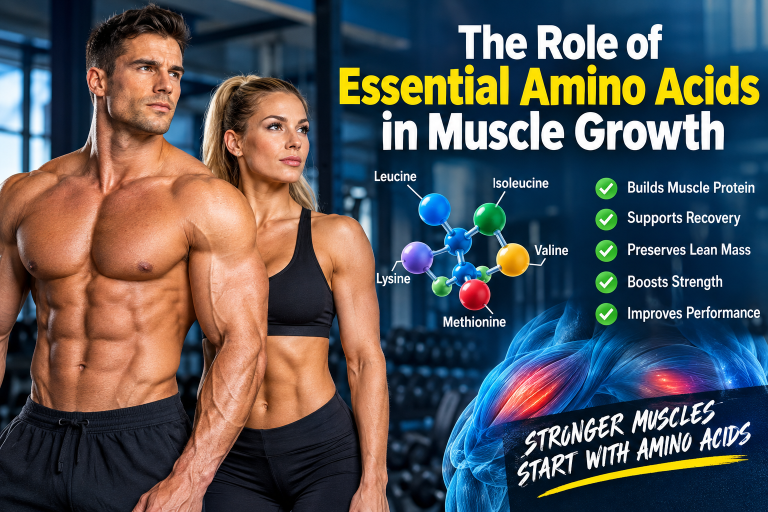
If your goal is to build muscle, get stronger, recover faster, and maintain lean muscle mass, amino acids deserve a place in your nutrition strategy. Amino acids are the building blocks of protein, and your body needs them to repair and build muscle tissue after resistance training.
But not all amino acids are the same. Nine amino acids are considered essential amino acids (EAAs) because your body cannot produce enough of them on its own. You must obtain them from food or supplements.
For bodybuilders and athletes, understanding amino acids and muscle growth can help you make better decisions about protein intake, workout nutrition, and supplementation.
In this guide, we’ll explain what amino acids are, the benefits of amino acids, how they support muscle growth, how much you need per day, whether you should take them before or after your workout, and which amino acids are most important for building lean muscle.
What Are Amino Acids?
Amino acids are organic compounds that combine to form proteins. Because muscle tissue is largely made up of protein, amino acids play an essential role in maintaining, repairing, and building muscle.
There are 20 amino acids commonly used by the human body to make proteins. Nine of these are classified as essential amino acids because the body cannot synthesize them in adequate amounts. The nine essential amino acids are:
- Histidine
- Isoleucine
- Leucine
- Lysine
- Methionine
- Phenylalanine
- Threonine
- Tryptophan
- Valine
The remaining amino acids are classified as nonessential or conditionally essential depending on the circumstances. Your body can generally produce nonessential amino acids, although requirements can change with factors such as training, illness, injury, or other physiological stress.
Why Are Essential Amino Acids Important for Muscle Growth?
Resistance training creates a stimulus for your muscles to adapt. Following training, your body needs sufficient amino acids to support the repair and remodeling of muscle proteins.
This is where dietary protein and essential amino acids become particularly important.
When you consume a complete protein source, it provides the essential amino acids your body needs to support muscle protein synthesis (MPS). MPS is the process through which your body creates new muscle proteins.
Over time, consistently stimulating muscle protein synthesis while providing adequate nutrition and training can contribute to increases in muscle size and strength.
However, amino acids aren’t a substitute for effective resistance training, adequate calories, sufficient protein, or recovery. They work as part of the bigger picture.
Amino Acids Benefits
Amino acids perform numerous functions throughout the body. For athletes and bodybuilders, several of their functions are particularly relevant.
1. Support Muscle Protein Synthesis
Essential amino acids provide the raw materials needed to build new muscle proteins. Certain amino acids, particularly leucine, also act as important signals involved in regulating muscle protein synthesis.
2. Help Repair Muscle After Training
Hard resistance training places stress on muscle tissue. Adequate protein and amino acid availability helps provide the materials needed for normal muscle repair and adaptation.
3. Help Maintain Lean Muscle Mass
Adequate protein and essential amino acid intake is particularly important when calories are restricted. During a fat-loss phase, maintaining resistance training and adequate protein intake can help preserve lean body mass.
4. Support Training Recovery
Recovery involves much more than simply taking a supplement. Sleep, calories, hydration, carbohydrates, protein, training volume, and stress management all matter. Amino acids can contribute to the nutritional side of the recovery process.
5. Provide Building Blocks for Many Body Functions
Amino acids aren’t exclusively used for muscle. They are involved in the production of enzymes, hormones, neurotransmitters, and other proteins throughout the body.
Amino Acids and Muscle Growth
The relationship between amino acids and muscle growth comes down to providing your body with the necessary materials to support muscle protein turnover.
When you perform resistance exercise, you create a powerful stimulus for your muscles to adapt. Eating enough high-quality protein supplies amino acids that can be used for muscle protein synthesis.
One of the most important amino acids in this process is leucine.
Leucine is one of the three branched-chain amino acids (BCAAs), along with isoleucine and valine. It plays an important signaling role in the regulation of muscle protein synthesis.
But there’s an important distinction: leucine alone isn’t enough to build muscle indefinitely. Your body also needs the other essential amino acids to provide the complete collection of building blocks required to synthesize new proteins.
That’s one reason complete protein sources and balanced essential amino acid formulas can be useful.
What Are the Best Amino Acids for Muscle Growth?
If your primary goal is muscle growth, the most important amino acids are the essential amino acids, because they cannot be produced by your body in sufficient amounts.
Leucine
Leucine is particularly important because it plays a key role in initiating and regulating muscle protein synthesis. It is one of the most extensively studied amino acids in relation to muscle metabolism.
Isoleucine
Isoleucine is a branched-chain amino acid involved in protein metabolism and energy production. It works alongside leucine and valine as part of the BCAA group.
Valine
Valine is the third BCAA and contributes to normal protein metabolism and muscle function.
Lysine
Lysine is an essential amino acid that the body needs to build proteins. It also has several other important physiological roles.
Methionine
Methionine is an essential amino acid involved in protein synthesis and methylation reactions throughout the body.
Threonine
Threonine is required for normal protein synthesis and is found in many structural proteins in the body.
The bottom line: when it comes to building muscle, thinking only about one amino acid misses the bigger picture. Your body needs all of the essential amino acids in adequate amounts to support the construction of new proteins.
How Much Amino Acid Do You Need Per Day?
There isn’t one universal daily dose of amino acids for everyone. Your requirements depend on your total protein intake, body size, age, training status, diet, and goals.
For most people who train regularly, the more useful starting point is to ensure adequate total daily protein rather than trying to calculate a separate dose of every amino acid.
For athletes and people engaged in resistance training, a commonly used evidence-based protein target is approximately 1.6 grams of protein per kilogram of body weight per day, with some individuals choosing higher intakes depending on their goals and circumstances.
For example, a 200-pound lifter weighs approximately 91 kilograms. A daily protein intake around 145 grams would correspond to 1.6 g/kg.
Instead of relying entirely on amino acid supplements, prioritize complete protein foods such as eggs, dairy, meat, fish, poultry, soy, and other high-quality protein sources.
An amino acid supplement can then be considered a convenient way to supplement your overall nutritional strategy.
Should You Take Amino Acids Before or After a Workout?
One of the most common questions athletes ask is whether amino acids should be taken before or after training.
The answer is that total daily protein and adequate nutrition are more important than obsessing over a precise minute on the clock.
Amino Acids Before a Workout
Taking amino acids before training can be convenient if you are training several hours after your previous protein-containing meal or prefer to consume amino acids around your workout.
For people who train early in the morning or train between meals, an amino acid supplement may provide a convenient source of essential amino acids around the workout period.
Amino Acids After a Workout
After resistance training, your muscles have an increased need for nutrients involved in repair and adaptation. Consuming a protein-rich meal or complete protein source after training can help provide the amino acids needed for muscle protein synthesis.
There is no requirement to consume amino acids immediately after the final repetition. The traditional idea of a tiny post-workout “anabolic window” has been oversimplified. What matters much more is your overall daily protein intake and how you distribute protein throughout the day.
Essential Amino Acids vs. Whey Protein
Whey protein and essential amino acid supplements are not identical products.
Whey is a complete protein that contains all nine essential amino acids along with other amino acids. It is an efficient way to increase daily protein intake.
An essential amino acid supplement provides the essential amino acids directly and can be useful when someone wants a convenient amino acid source without consuming a full serving of protein.
It’s therefore too simplistic to say that amino acids are universally “better” than whey protein. For someone who struggles to consume enough total protein, whey protein can be extremely useful because it contributes substantially to daily protein intake.
For someone who already consumes plenty of protein and wants a convenient amino acid supplement around training, an EAA or amino acid formula may serve a different purpose.
Nitrobol Amino Acid Complex for Bodybuilding
Nitrobol Amino Acid Complex from Truly Huge Supplements is formulated as an amino acid supplement for bodybuilders and athletes who want to support their training, recovery, and lean muscle-building goals.
The idea behind an amino acid supplement is straightforward: provide the body with amino acids that can be used in protein metabolism without requiring you to consume another full meal.
For serious lifters, convenience can be important. A quality amino acid supplement can be used alongside a well-designed diet, resistance-training program, adequate protein intake, and sufficient recovery.
Nitrobol can be incorporated into a bodybuilding nutrition program around training or at other times of the day according to the product directions.
Nitrobol Amino Acid Complex Reviews
Customer experiences can provide useful insight into how people use a supplement, although individual testimonials should not be interpreted as proof that everyone will experience the same results.
Patrick L. Deu Pree — 69 Years Old
“I am 69 years old and I still train hard. Nitrobol Amino Acid Complex from Trulyhuge Supplements really help me keep up my training intensity. And aid in recovery. And also, I find I have more mental clarity which is a plus, I am a writer.”
Patrick says that Nitrobol has helped him maintain his training intensity and recovery and recommends it to hard-training bodybuilders and athletes.
Lionel Pope II — Orlando, Florida
“For a long time I was stuck at 165 but today I am 186… and STILL growing.”
Lionel reported gaining approximately 20 pounds during the seven weeks after starting Nitrobol. His experience is an individual testimonial and shouldn’t be taken as a typical expected result. Changes in body weight can also reflect factors beyond muscle tissue, including food intake, water, glycogen, and other variables.
Eddie De La Cruz — Bronx, New York
“After 6 weeks I have experienced the rare privilege of being reintroduced to some very old friends of mine… MY ABS!”
Eddie reported improved definition and said that he could see his abs again after six weeks of using Nitrobol.
Richard Smith — Phoenix, Arizona
“Since starting Nitrobol my bench press is up to 215lbs from 185lbs.”
Richard reported taking Nitrobol after his workouts and in the morning and associated its use with improvements in his bench press and overall muscular definition.
What About Using Amino Acids After a Steroid Cycle?
Some bodybuilders use amino acid supplements when transitioning away from anabolic steroids. However, amino acids should not be considered a substitute for medical care or evidence-based post-cycle management.
Nitrobol’s customer testimonials include people who reported using it after steroid cycles. These are individual experiences and do not establish that an amino acid supplement can prevent the loss of steroid-associated muscle or restore hormone production after anabolic steroid use.
If you have used anabolic steroids or other performance-enhancing drugs, speak with a qualified healthcare professional about appropriate medical evaluation and recovery.
How to Use Amino Acids for Maximum Muscle Growth
If building muscle is your goal, think about amino acids as one part of a complete muscle-building system.
- Train with progressive resistance. Give your muscles a consistent reason to adapt by using an intelligently designed resistance-training program.
- Eat enough protein. Make adequate daily protein intake the foundation of your nutrition plan.
- Consume high-quality protein sources. Include foods that provide all of the essential amino acids.
- Distribute protein throughout the day. Rather than consuming almost all of your protein in one meal, spread protein-containing meals across the day.
- Use amino acid supplements strategically. Consider them a convenient addition to an already solid nutrition program.
- Eat enough calories. Building substantial amounts of muscle is difficult when you consistently consume too few calories.
- Get adequate sleep. Recovery is an essential part of the muscle-building process.
- Stay consistent. Muscle growth takes months and years of consistent training and nutrition—not a few days of supplementation.
Can Amino Acids Help You Build Muscle?
Yes, amino acids are essential to the process of building and maintaining muscle because they provide the components required to make new proteins.
However, an amino acid supplement isn’t a magic muscle-building shortcut. The biggest factors remain consistent resistance training, adequate protein and calorie intake, recovery, and time.
If your diet already provides sufficient high-quality protein, an amino acid supplement may offer less additional benefit than it would for someone whose diet is lacking in protein. The value of supplementation depends heavily on the individual’s overall nutrition.
Who Should Consider an Amino Acid Supplement?
An amino acid supplement may be particularly convenient for:
- Bodybuilders who train frequently
- Athletes with demanding training schedules
- People who want an amino acid source around workouts
- Lifters who have difficulty consuming protein-containing meals around training
- People who want to supplement an already adequate nutrition program
However, supplements should complement—not replace—a nutritious diet.
Frequently Asked Questions About Amino Acids and Muscle Growth
What are amino acids?
Amino acids are compounds that combine to form proteins. They are essential for building and repairing tissues and performing numerous other functions in the body.
What are essential amino acids?
Essential amino acids are amino acids that your body cannot produce in sufficient amounts and therefore must obtain from food or supplements.
Which amino acid is best for muscle growth?
Leucine is particularly important because it plays a major signaling role in muscle protein synthesis. However, muscle protein synthesis requires the availability of all the essential amino acids, making complete protein and balanced EAA intake important.
How much amino acid should I take per day?
There isn’t one recommended daily dose of an amino acid supplement for everyone. Your overall protein requirement is generally the more important target. People who train regularly often benefit from approximately 1.6 g/kg/day of protein, with individual needs varying.
Should I take amino acids before or after my workout?
Either can be appropriate. Your total daily protein intake and overall nutrition are more important than taking amino acids at an exact time. Follow the serving instructions for your specific supplement.
Are amino acids better than whey protein?
Not necessarily. Whey protein provides a complete protein source and can be an excellent way to increase total daily protein. An amino acid supplement provides amino acids more directly and may be convenient around training. The best choice depends on your diet and nutritional needs.
Can amino acids help preserve muscle while dieting?
Adequate protein intake and resistance training are important for maintaining lean mass during a calorie deficit. Essential amino acids contribute to the process of maintaining and producing muscle proteins, but an amino acid supplement should not be viewed as a replacement for adequate dietary protein.
Are amino acids important for older bodybuilders?
Yes. Adequate high-quality protein and essential amino acids remain important throughout adulthood. Older adults may also need to pay particular attention to total protein intake and the quality and distribution of protein across meals.
The Bottom Line on Essential Amino Acids and Muscle Growth
Essential amino acids play a fundamental role in muscle growth because your body needs them to produce new proteins. Among them, leucine is especially important for signaling muscle protein synthesis, but all of the essential amino acids contribute to the process.
If you’re serious about building lean muscle, start with the fundamentals: progressive resistance training, adequate calories, sufficient daily protein, quality nutrition, hydration, and sleep. Once those foundations are in place, an amino acid supplement such as Nitrobol Amino Acid Complex can be a convenient addition to your bodybuilding nutrition program.
The goal isn’t simply to take more supplements. The goal is to provide your body with the training stimulus, nutrients, and recovery it needs to build muscle consistently over time.
Train hard. Eat right. Recover. Repeat.
Shop Truly Huge Bodybuilding Supplements
Email support@trulyhugebodybuilding.com or call (800) 635-8970 with any questions you have and we’ll be happy to help you find the best supplements for your bodybuilding and fitness goals.