
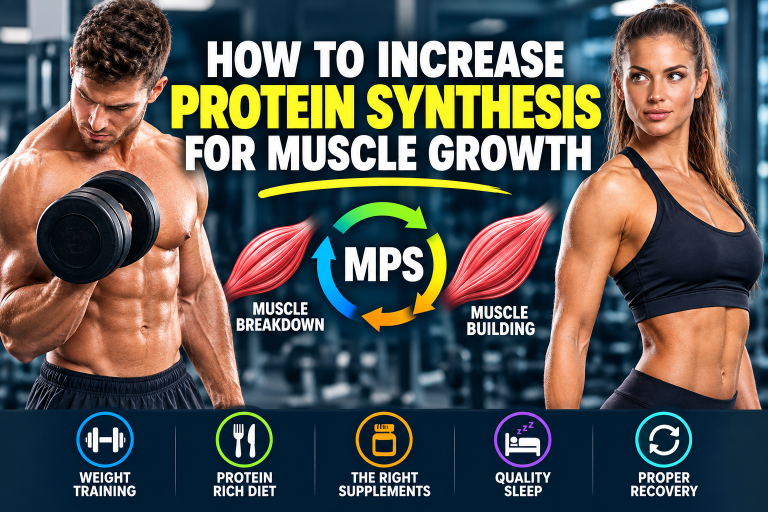
If your goal is to build more muscle mass, one of the most important processes to understand is muscle protein synthesis (MPS). Your muscles are constantly breaking down and rebuilding proteins, and the key to gaining muscle is creating an environment where muscle protein synthesis consistently exceeds muscle protein breakdown.
So, how do you increase protein synthesis for muscle growth?
The foundation is relatively simple: progressive resistance training, adequate daily protein, sufficient calories, proper recovery, and strategic nutrition and supplementation.
When these factors are combined, you give your body the raw materials and training stimulus it needs to repair damaged muscle tissue and build new muscle proteins.
What Is Protein Synthesis?
Protein synthesis is the biological process your cells use to build new proteins in the body. Proteins are essential components of muscle tissue, organs, enzymes, hormones, and many other structures throughout the body.
For bodybuilding and muscle growth, the most important form is muscle protein synthesis (MPS).
When you train with weights, consume protein, and recover properly, your body receives signals to produce new muscle proteins. These newly created proteins help repair and remodel muscle tissue following training.
What Is Muscle Protein Synthesis?
Muscle protein synthesis is the metabolic process through which your body creates new muscle proteins. It plays a central role in repairing and adapting your muscles after resistance exercise.
However, simply increasing MPS does not automatically ensure muscle growth.
Muscle tissue is constantly undergoing both muscle protein synthesis and muscle protein breakdown. To gain muscle mass over time, muscle protein synthesis needs to exceed muscle protein breakdown consistently enough to produce a positive net muscle protein balance.
This is why your training, diet, sleep, and recovery all matter when you’re trying to build muscle.
How to Increase Protein Synthesis After Weight Training
Resistance training is one of the most powerful ways to stimulate muscle protein synthesis.
When you lift weights, your muscles experience mechanical tension and other forms of stress that initiate cellular signaling involved in muscle adaptation. Your body responds by increasing the production of muscle proteins involved in repairing and remodeling the trained tissue.
Following a resistance-training workout, muscle protein synthesis becomes elevated. The duration of this response varies depending on factors such as training status, workout intensity, muscle group, nutrition, and the type of exercise performed.
For this reason, your workout is only one part of the muscle-building equation. You also need to provide your body with sufficient protein, energy, and recovery time.
Does Training More Frequently Increase Muscle Protein Synthesis?
Training frequency can be an important consideration for maximizing muscle growth.
Rather than training a muscle extremely hard once and then waiting a long time before training it again, many lifters can benefit from distributing their weekly training volume across multiple sessions.
Training a muscle two or more times a week can make it easier to accumulate productive training volume while providing repeated opportunities to stimulate muscle protein synthesis.
This can be particularly useful for lagging body parts. For example, instead of training a weak muscle only once a week, you might distribute its weekly workload over two or three sessions, provided you can recover adequately.
More frequent training isn’t automatically better, however. The goal is to provide enough training stimulus to promote adaptation without accumulating so much fatigue that performance and recovery suffer.
Protein Synthesis Diet for Muscle Growth
A muscle-building diet should provide your body with the energy and nutrients required to support training, recovery, and new tissue growth.
A protein synthesis diet should focus on several important factors:
- Adequate daily protein to provide amino acids for muscle protein synthesis.
- Sufficient calories to support training and muscle growth.
- High-quality protein sources containing all of the essential amino acids.
- Carbohydrates to support training performance and replenish muscle glycogen.
- Healthy dietary fats to support overall health and normal physiological function.
- Proper meal distribution so protein is consumed regularly throughout the day.
- Plenty of fluids to support normal physiological processes and exercise performance.
For most people trying to gain muscle, total daily protein intake is more important than obsessing over a precise minute-by-minute nutrient timing strategy.
However, spreading protein intake across several meals can be a practical way to provide your muscles with repeated supplies of amino acids throughout the day.
How Much Protein Do You Need for Muscle Growth?
Getting enough protein every day is one of the most important nutritional factors for maximizing your ability to build muscle.
For people who regularly perform resistance training, a daily protein intake in the range of approximately 1.6 to 2.2 grams of protein per kilogram of body weight is commonly used as a practical target for maximizing muscle-building benefits.
For example, someone weighing 180 pounds (about 82 kg) could consume approximately 130–180 grams of protein a day.
Your exact needs can vary depending on body composition, training volume, calorie intake, age, and individual circumstances.
Protein Powder for Muscle Protein Synthesis
A convenient way to increase daily protein intake is with a complete protein powder.
High-quality protein powders provide essential amino acids that your body can use to synthesize new muscle proteins. Protein supplements can be particularly useful when whole-food protein sources aren’t convenient or when you have difficulty consuming enough protein through meals alone.
Bio-Available Protein, for example, is designed as a convenient protein source for people looking to increase their daily protein intake while supporting muscle recovery and growth.
One of the important amino acids in a complete protein source is leucine. Leucine plays a key role in signaling pathways involved in muscle protein synthesis.
Protein powder shouldn’t replace a nutritious diet, but it can be an effective tool for helping you consistently reach your daily protein target.
Amino Acids for Protein Synthesis
Amino acids are the building blocks of proteins. When you eat protein, your digestive system breaks it down into amino acids that can then be used to create new proteins throughout the body.
The essential amino acids (EAAs) are particularly important because your body cannot manufacture them in sufficient quantities and they must be obtained from your diet.
Essential amino acids include leucine, isoleucine, valine, lysine, methionine, phenylalanine, threonine, tryptophan, and histidine.
An amino acid supplement such as Nitrobol Amino Acid Complex can provide a convenient source of amino acids around workouts or between meals.
However, amino acid supplements should generally be viewed as a complement to adequate total daily protein intake rather than a replacement for sufficient dietary protein.
Ecdysterone and Muscle Protein Synthesis
Ecdysterone, also known as beta-ecdysterone or 20-hydroxyecdysone, is a naturally occurring compound found in certain plants and insects that has attracted interest in the sports nutrition and bodybuilding communities.
Research has investigated whether ecdysterone may influence pathways involved in muscle growth and protein synthesis. Some human research has reported potential benefits for resistance-trained individuals, although the evidence base is still considerably smaller than it is for established supplements such as protein and creatine.
Ecdy-Bolin contains beta-ecdysterone and is designed for people interested in incorporating ecdysterone into their bodybuilding supplement program.
It is important to distinguish ecdysterone from anabolic steroids. Ecdysterone is not an anabolic-androgenic steroid, and claims about its effects should be kept within the limits of the available scientific evidence.
Best Supplements for Increasing Muscle Protein Synthesis
If your goal is to maximize muscle protein synthesis, supplements should come after the fundamentals of training, nutrition, and recovery are in place.
Some of the most relevant supplements include:
1. Complete Protein Powder
A complete protein powder can make it easier to reach your daily protein target and provide the essential amino acids required for muscle protein synthesis.
2. Essential Amino Acids
Essential amino acids provide the amino acids your body cannot produce on its own. They can be particularly convenient around training or when a complete protein meal isn’t available.
3. Ecdysterone
Ecdysterone is an emerging bodybuilding supplement that has been studied for its potential effects on muscle growth and protein synthesis. More research is needed to establish exactly how effective it is compared with better-established sports nutrition supplements.
4. Creatine
Creatine does not work primarily by directly stimulating muscle protein synthesis, but it is one of the most extensively studied supplements for improving strength, training performance, and lean mass gains. By helping you train harder and perform more quality work, creatine can support the overall muscle-building process.
Does Protein Timing Matter for Muscle Growth?
Protein timing can play a role in maximizing the muscle-building response to resistance exercise, but total daily protein intake remains a major priority.
A practical approach is to consume protein-containing meals throughout the day rather than consuming nearly all of your protein in one meal.
Having a high protein meal before or after training can provide amino acids during the period when your muscles are recovering from exercise. There is no need to obsess over a tiny post-workout window, though. Your muscles remain responsive to nutrition for considerably longer than a few minutes after your workout.
Sleep and Protein Synthesis
Training and nutrition receive most of the attention in bodybuilding, but recovery is equally important.
During recovery, your body repairs the tissues stressed by training and adapts to the demands placed upon it. Consistently getting enough quality sleep supports normal recovery, physical performance, and the processes involved in muscle growth.
A hard workout followed by inadequate sleep and poor nutrition is not an effective long-term muscle-building strategy.
How to Maximize Muscle Protein Synthesis
If you want to increase muscle protein synthesis and build more muscle, focus on the fundamentals consistently:
- Perform progressive resistance training. Gradually increase training performance over time while maintaining good exercise technique.
- Train each muscle regularly. Many lifters can benefit from training major muscle groups at least twice a week.
- Eat enough protein. Aim for approximately 1.6–2.2 grams of protein per kilogram of body weight a day as a practical starting range.
- Eat enough calories. Building significant amounts of muscle is easier when your body has adequate energy available.
- Spread protein throughout the day. Include a quality protein source in several meals.
- Use supplements strategically. Protein powder, amino acids, creatine, and potentially ecdysterone can complement a solid diet and training program.
- Get adequate sleep. Give your body enough time to recover and adapt between workouts.
- Be consistent. Muscle growth is the result of repeatedly applying these principles over weeks, months, and years.
Final Thoughts on Increasing Protein Synthesis for Muscle Growth
Increasing muscle protein synthesis is an important part of building muscle, but it shouldn’t be viewed as a single process that can be maximized with one food or supplement.
The most effective approach is to combine progressive resistance training, adequate high-quality protein, sufficient calories, good nutrition, proper recovery, and consistent sleep.
Protein powder and amino acid supplements can help you meet your nutritional needs, while supplements such as ecdysterone may provide another option for experienced lifters interested in additional strategies for supporting muscle growth.
Ultimately, the goal is to create a consistent environment in which your body has both the training stimulus and nutritional resources needed to repair and build new muscle tissue.
If you consistently train hard, eat enough protein and calories, recover properly, and give the process enough time, you will be in a much better position to maximize your muscle-building potential.
Shop Truly Huge Bodybuilding Supplements
Email support@trulyhugebodybuilding.com or call (800) 635-8970 with any questions you have and we’ll be happy to help you find the best supplements for your bodybuilding and fitness goals.