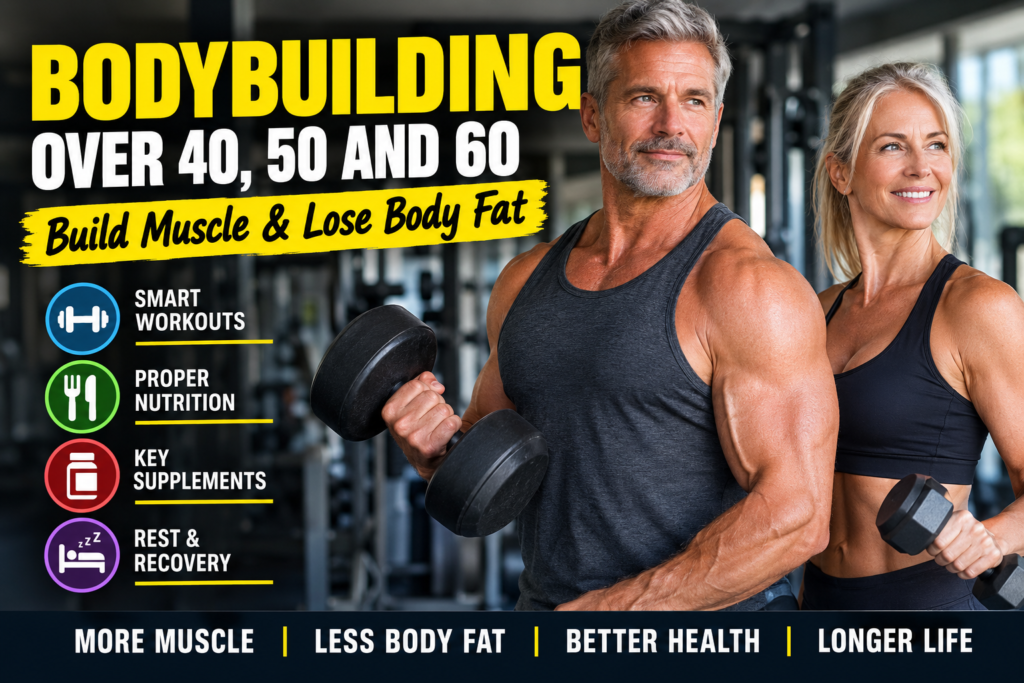
Bodybuilding over 40, 50, 60 and beyond is absolutely possible. In fact, building and maintaining muscle may become even more important as you get older. The right combination of resistance training, nutrition, recovery and carefully selected supplements can help you build muscle, reduce body fat, maintain strength and improve your quality of life.
Getting older does not mean you have to accept losing muscle or becoming weaker. However, your approach to bodybuilding may need to change. Recovery becomes increasingly important, exercise selection matters more, and your diet needs to provide enough protein and nutrients to support muscle growth.
Whether your goal is to add muscle after 40, get lean after 50, or continue bodybuilding in your 60s and beyond, the basic principles remain the same: train hard, eat intelligently, recover adequately and remain consistent.
Why Bodybuilding Becomes More Important After 40
Beginning around middle age, adults can gradually lose muscle mass and strength if they do not actively work to maintain them. This age-related decline in muscle is commonly associated with sarcopenia.
Resistance training is one of the most effective tools for fighting this decline. Regular strength training gives your muscles a reason to remain strong and functional while also supporting bone health, physical performance and metabolic health.
More muscle can also make it easier to maintain a healthy body composition. Muscle tissue requires energy, and maintaining an active lifestyle helps you manage body weight while preserving strength and physical independence.
This is why bodybuilding after 40, 50 and 60 should not be viewed simply as an attempt to look better in the mirror. It can be part of a long-term strategy for maintaining strength, mobility and quality of life.
Bodybuilding Over 40
For many people, their 40s are an excellent time to become more serious about bodybuilding. You can still build substantial amounts of muscle, but recovery and injury prevention should receive more attention than they did when you were younger.
Your goal should not be to train like you are 20. Your goal should be to train effectively for the body you have today.
Best Workout Approach After 40
A bodybuilding workout over 40 should emphasize progressive resistance training while keeping good form and recovery at the center of the program.
- Use controlled lifting technique.
- Perform a thorough warm-up before heavy training.
- Focus on compound exercises and productive isolation exercises.
- Progress gradually rather than forcing weight increases every workout.
- Avoid unnecessary high-volume training.
- Allow adequate recovery between hard sessions.
- Use different repetition ranges rather than training exclusively with very heavy weights.
You do not need to destroy your muscles every workout. The objective is to provide enough training stimulus to encourage adaptation while leaving enough recovery capacity to grow.
Bodybuilding Over 50
Bodybuilding over 50 requires even more attention to recovery, mobility, exercise selection and nutrition. However, people in their 50s can still make impressive improvements in muscle mass and strength.
One of the biggest mistakes older lifters make is assuming that aging means they should stop training hard. Instead, you should learn how to distinguish between productive intensity and unnecessary fatigue.
Train with purpose. Use challenging weights, but maintain control and proper technique. If an exercise consistently causes joint pain, replace it with another movement that trains the same muscle more comfortably.
Training Frequency After 50
Many lifters over 50 do well with three or four resistance-training sessions a week. This provides enough stimulation while leaving recovery days between workouts.
A simple schedule could include:
- Monday: Chest, shoulders and triceps
- Wednesday: Legs and abs
- Friday: Back and biceps
Another effective option is a full-body workout three times a week. The best program is the one you can perform consistently while recovering between sessions.
Bodybuilding Over 60
Bodybuilding over 60 is not about trying to prove that you can train like a 25-year-old. It is about getting the greatest possible benefit from resistance training while minimizing unnecessary wear and tear.
Older lifters should place a particularly high value on warm-ups, mobility, exercise technique, recovery and gradual progression.
Machines and cable exercises can also be extremely useful. They allow you to train a muscle effectively without always requiring the balance, stabilization or joint positioning associated with certain free-weight movements.
Heavy training can still have a place in a program for an experienced lifter over 60, but there is no requirement to constantly test your maximum strength. Moderate loads performed with excellent technique can provide a highly productive muscle-building stimulus.
The Best Bodybuilding Workout Over 40, 50 and 60
There is no single workout that is perfect for everyone over a particular age. Your training experience, joint health, recovery ability and goals should determine your program.
A basic three-day bodybuilding routine could look like this:
Workout 1 – Chest, Shoulders and Triceps
- Bench press or machine chest press – 3 sets
- Incline dumbbell press – 2–3 sets
- Lateral raises – 3 sets
- Shoulder press – 2 sets
- Triceps pushdowns – 2–3 sets
Workout 2 – Legs and Abs
- Leg press or squat variation – 3 sets
- Romanian deadlift – 2–3 sets
- Leg curl – 3 sets
- Leg extension – 2 sets
- Calf raises – 3 sets
- Abdominal exercise – 2–3 sets
Workout 3 – Back and Biceps
- Lat pulldown or assisted pull-up – 3 sets
- Seated cable row – 3 sets
- Chest-supported row – 2 sets
- Face pulls or rear-delt raises – 2–3 sets
- Dumbbell curls – 2–3 sets
- Hammer curls – 2 sets
Start with manageable weights and focus on progression over time. Depending on your experience and recovery, you can adjust the number of sets, repetitions and training days.
How Hard Should You Train After 40?
Training intensity remains important as you age. Your muscles still need a sufficient stimulus to adapt and grow.
However, training harder does not necessarily mean training to absolute failure on every set.
For many older lifters, stopping a set when you have approximately one or two good repetitions left can provide an excellent balance between training stimulus and recovery. Occasional failure training can be used selectively, particularly on safer isolation exercises.
The key is to avoid turning every workout into a recovery problem.
Bodybuilding Diet Over 40, 50 and 60
Your diet becomes increasingly important as you get older. A bodybuilding diet over 40, 50 and 60 should provide enough protein, calories, carbohydrates, healthy fats, vitamins and minerals to support training and recovery.
Protein deserves particular attention because aging can be associated with anabolic resistance, meaning the muscles may not respond to a given amount of dietary protein as efficiently as they did when you were younger.
Eat Enough Protein
A practical starting point for many active adults is approximately 1.6 grams of protein per kilogram of body weight a day, with individual needs varying according to body composition, training, calorie intake and health considerations.
Good protein sources include:
- Eggs
- Chicken and turkey
- Lean beef
- Fish
- Greek yogurt
- Cottage cheese
- Milk
- Protein powder
- Other high-quality protein foods
Rather than eating almost all of your protein in one meal, spreading protein intake throughout the day can be a practical way to consistently provide your muscles with the amino acids they need.
Carbohydrates for Training Energy
Carbohydrates are not the enemy when you are trying to build muscle or lose fat. They provide an important source of energy for resistance training.
Choose primarily nutrient-dense carbohydrate sources such as oats, potatoes, rice, fruit, vegetables and whole grains.
The amount you need will depend on your training volume, body size and goals. Someone trying to gain muscle will generally need more calories than someone aggressively trying to lose body fat.
Healthy Fats and Hormonal Health
Do not eliminate dietary fat from your bodybuilding diet. Healthy fats provide essential fatty acids and help make a diet more satisfying.
Good choices include olive oil, avocados, nuts, seeds and fatty fish.
Rather than relying on supplements to compensate for a poor diet, build your nutrition plan around whole foods first.
Building Muscle While Losing Body Fat After 40
One of the most common goals for people over 40, 50 and 60 is to gain muscle while losing body fat.
This can be challenging, but it is possible, particularly for people who are new to resistance training, returning after a long break, or carrying excess body fat.
A successful body recomposition strategy generally includes:
- Progressive resistance training
- High-quality protein intake
- A moderate calorie deficit if fat loss is the priority
- Adequate carbohydrates to support training
- Healthy dietary fats
- Regular low- to moderate-intensity cardiovascular activity
- Plenty of sleep and recovery
Avoid extreme dieting. Losing weight too quickly can make it harder to preserve muscle and maintain training performance.
Muscle-Building Supplements Over 40, 50 and 60
The right bodybuilding supplements can complement a good training and nutrition program. They should not replace adequate protein, calories, sleep or resistance training.
Protein
Protein powder is one of the most convenient supplements for older bodybuilders. It makes it easier to reach your daily protein target, particularly when whole-food protein is inconvenient.
Whey, egg, milk-based protein blends and other high-quality protein powders can be useful additions to a muscle-building diet.
Amino Acids
Amino acids are the building blocks of protein. Adequate essential amino acids, particularly the branched-chain amino acids found in complete protein sources, are important for muscle protein synthesis.
Amino acid supplements may be particularly convenient around training or when dietary protein intake is limited. However, they work best as a complement to an adequate overall protein intake.
Creatine
Creatine is one of the most extensively studied sports supplements and can be particularly useful for adults interested in maintaining strength and muscle as they age.
Creatine supplementation, combined with resistance training, can support improvements in strength and lean mass.
Testosterone Boosters
Starting around age 30 to 40, your testosterone levels can drop by 1% to 2% per year. Men over 40, 50, and 60 use testosterone booster supplements to help address this natural gradual decline in testosterone production that goes along with getting older.
HGH Boosters
Growth hormone is involved in many physiological processes, including tissue growth and recovery. Growth hormone secretion also changes with age and is influenced by factors such as sleep and exercise.
By age 40, HGH production drops significantly, and by age 50 or 60, levels can be even lower. People over 40, 50, and 60 use HGH booster supplements to help support their body’s natural production of human growth hormone.
HGH boosters should be viewed realistically, they are not equivalent to prescription growth hormone.
Sleep and Recovery After 40, 50 and 60
Recovery is one of the biggest differences between bodybuilding when you are young and bodybuilding later in life.
You may be able to train hard, but you cannot necessarily recover from unlimited amounts of training. This makes sleep and rest critical components of your bodybuilding program.
Aim for approximately seven to nine hours of quality sleep when possible. Give heavily trained muscle groups enough time to recover before training them hard again.
Remember that muscle is built during recovery, not while you are lifting weights. Training provides the stimulus; nutrition and recovery provide the resources for adaptation.
Cardio for Bodybuilders Over 40, 50 and 60
Cardiovascular exercise can complement bodybuilding by supporting cardiovascular fitness, work capacity and calorie management.
You do not need hours of exhausting cardio. Walking, cycling, swimming and other forms of moderate cardiovascular exercise can be incorporated without interfering with resistance training.
If muscle gain is your primary objective, schedule cardio so that it does not consistently interfere with your most important weight-training sessions.
Common Bodybuilding Mistakes After 40
Older lifters can make excellent progress, but certain mistakes can slow their results.
- Training too much: More training is not automatically better.
- Ignoring joint pain: Modify exercises rather than repeatedly aggravating an injury.
- Not eating enough protein: Protein becomes especially important as you age.
- Using extreme diets: Crash diets can make muscle retention more difficult.
- Ignoring sleep: Poor recovery can undermine otherwise excellent training.
- Always lifting maximally heavy: You can build muscle without constantly testing your maximum strength.
- Changing programs too frequently: Give a well-designed program enough time to produce measurable results.
- Expecting overnight results: Muscle growth is a long-term process at any age.
Can You Still Build Muscle After 60?
Yes, you can still build muscle after 60. The rate of progress may differ from when you were younger, but age does not eliminate your ability to respond to resistance training.
The most important factors are consistency, adequate training stimulus, sufficient protein and calories, recovery and realistic progression.
For older adults, the goal should not simply be to add pounds to the scale. Building functional muscle, maintaining strength and staying lean can be far more valuable than chasing rapid increases in body weight.
Bodybuilding Over 40, 50 and 60: The Bottom Line
Bodybuilding does not have an expiration date.
Whether you are 40, 50, 60 or beyond, resistance training can be an important part of maintaining muscle, strength and physical function. The difference is that successful older bodybuilders learn to train smarter as well as harder.
Focus on progressive resistance training, excellent form, adequate protein, nutritious foods, sufficient sleep and appropriate recovery. Add supplements such as protein and creatine when they help fill specific nutritional or performance needs.
Most importantly, think long term. You do not need to have the biggest workout today. You need to keep training consistently for the next five, ten and twenty years.
Building muscle after 40, 50 and 60 is not about fighting your age. It is about using smart training, nutrition and recovery to make the most of the body you have at every stage of life.
recovery.
Shop Truly Huge Bodybuilding Supplements
Email support@trulyhugebodybuilding.com or call (800) 635-8970 with any questions you have and we’ll be happy to help you find the best supplements to help you reach your bodybuilding and fitness goals.