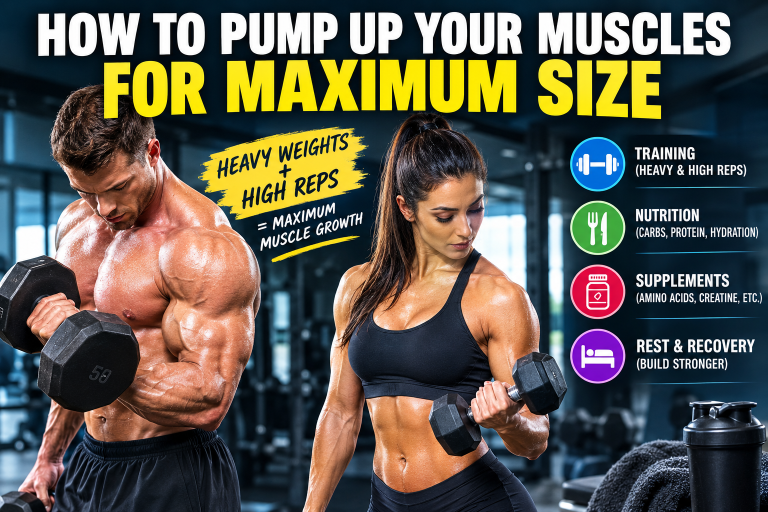
What is better for building muscle size: heavy weights for low reps or lighter weights for higher reps?
The truth is, if your goal is to build maximum muscle size, you don’t necessarily have to choose one or the other. A well-designed bodybuilding program can use both heavy training and lighter, higher-repetition pump training to stimulate muscle growth through different mechanisms.
Heavy training emphasizes mechanical tension and can contribute to myofibrillar hypertrophy—the growth and remodeling of the contractile components of muscle fibers. Lighter, higher-repetition training can produce substantial metabolic stress and a pronounced muscle pump, alongside hypertrophic adaptations.
Put these training approaches together with progressive overload, adequate nutrition, recovery, and consistency, and you have a powerful strategy for maximizing muscle growth.
How to Achieve Maximum Muscle Growth
Building maximum muscle size requires more than simply lifting the heaviest weight possible. Your muscles respond to a combination of mechanical tension, sufficient training volume, metabolic stress, recovery, and nutrition.
Heavy sets performed with challenging weights place substantial mechanical tension on the muscles. This makes exercises such as the bench press, squat, deadlift, overhead press, rows, and other compound movements valuable parts of a muscle-building program.
Higher-repetition training adds another useful tool. Sets performed with lighter weights and higher repetitions can produce considerable metabolic stress, local fatigue, and the familiar swelling known as the pump.
Rather than asking whether heavy or light training is better, a more useful question is: How can you use both effectively?
What Is the Pump in Bodybuilding?
The muscle pump is the temporary swelling, fullness, and firmness you experience in a muscle during and immediately after resistance training.
When you perform repeated contractions, blood flow to the working muscles increases. Metabolites accumulate within the muscle, fluid shifts occur, and the muscle temporarily becomes larger and fuller.
This is one reason high-repetition bodybuilding sets can produce such a dramatic visual effect.
However, it is important to understand that the pump itself is temporary. A muscle looking significantly larger immediately after training does not mean that all of that additional size represents permanent muscle tissue.
At the same time, the physiological processes associated with hard resistance training—including mechanical tension, metabolic stress, and cellular changes—can contribute to the signaling and adaptations involved in muscle hypertrophy.
Myofibrillar vs. Sarcoplasmic Hypertrophy
One reason bodybuilders have traditionally used different repetition ranges is that resistance training can produce adaptations involving different components of muscle tissue.
Myofibrillar Hypertrophy
Myofibrillar hypertrophy refers to increases in the size and amount of the contractile machinery within muscle fibers, including the proteins responsible for producing force.
Heavy resistance training with challenging loads provides high levels of mechanical tension and can stimulate these adaptations while also improving strength.
Sarcoplasmic Adaptations
Sarcoplasmic hypertrophy refers to increases in the volume of the non-contractile components within muscle fibers, including fluid, glycogen, and other cellular contents.
Higher-volume bodybuilding training can produce substantial metabolic stress and may contribute to increases in these components.
For someone whose primary objective is maximum muscular development, there is little reason to limit yourself to a single repetition range. Combining different loading and repetition strategies allows you to train for both strength and muscular size.
Why the Muscle Pump May Help Muscle Growth
The muscle pump isn’t simply something bodybuilders chase because it looks impressive in the mirror. The physiological changes that accompany intense training are relevant to muscle adaptation.
One proposed mechanism is cellular swelling. As fluid shifts into muscle cells during exercise, the cells experience changes in their physical environment. Research into cellular signaling suggests that changes in cell hydration and swelling can interact with pathways involved in muscle protein turnover and adaptation.
However, the pump should not be considered a standalone requirement for muscle growth. You can build significant muscle without experiencing a huge pump during every workout. Progressive resistance training and adequate recovery remain fundamental.
Benefits of the Muscle Pump
1. Cellular Swelling
One of the most noticeable effects of the pump is cellular and tissue swelling. Working muscles temporarily become fuller as blood flow and fluid distribution change during exercise.
2. Increased Blood Flow
Resistance exercise increases blood flow to active muscle tissue. This increased circulation helps deliver oxygen and nutrients while supporting the demands of intense exercise.
3. Metabolic Stress
High-repetition training with shorter rest periods can create significant metabolic stress. This is one reason pump-style training is commonly used by bodybuilders as a complement to heavier strength-oriented work.
4. Improved Mind-Muscle Connection
When a muscle becomes highly fatigued and pumped, many lifters find it easier to concentrate on that muscle contracting through the movement. Developing this mind-muscle connection can be particularly useful during isolation exercises.
5. Motivation
There is also a psychological benefit to getting a great pump. Seeing and feeling your muscles become fuller during a workout can provide immediate feedback that makes training more enjoyable and motivating.
Arnold Schwarzenegger famously spoke about how much he enjoyed the feeling of the pump. For generations of bodybuilders, that sensation has become one of the defining experiences of resistance training.
Arthur Jones and the Muscle Pump
Arthur Jones, the founder of the High Intensity Training movement and creator of Nautilus exercise equipment, placed considerable emphasis on high-intensity training and muscular fatigue.
Jones also discussed the relationship between a muscle’s pumped appearance and its potential future development. While the size of a temporary pump cannot literally predict exactly how large a muscle will become, the idea captures an important bodybuilding principle: training should create a strong stimulus for adaptation rather than simply moving weights from one position to another.
How to Use the Pump for Muscle Growth
The best way to incorporate pump training is not necessarily to turn your entire workout into endless sets of 20 or 30 repetitions.
Instead, combine heavy compound movements with lighter pump-focused exercises.
A simple structure is:
- Heavy compound exercise: approximately 6–10 challenging repetitions.
- Longer rest: around 2–3 minutes when necessary to maintain performance.
- Isolation or machine exercise: approximately 12–20 repetitions.
- Shorter rest: roughly 45–60 seconds for a strong pump.
- Progressive overload: gradually increase repetitions, resistance, or training quality over time.
The exact repetition ranges do not need to be rigid. Muscle can be built across a relatively broad range of repetitions when sets are sufficiently challenging and total training is appropriately programmed.
Muscle Pump Workout Routine
Here’s an example of how you could combine heavy training with pump-focused work for the chest.
Exercise 1: Bench Press
3–4 sets × 6–10 repetitions
Rest: 2–3 minutes
Use a challenging weight while maintaining good technique. The goal is to generate substantial mechanical tension and progressively improve your performance over time.
Exercise 2: Incline Dumbbell Press
3 sets × 8–12 repetitions
Rest: 90–120 seconds
Use controlled repetitions and focus on moving through a comfortable range of motion.
Exercise 3: Pec Deck or Cable Fly
3 sets × 12–20 repetitions
Rest: 45–60 seconds
This is where you can deliberately chase the pump. Use a lighter weight, controlled repetitions, and short rest periods to accumulate fatigue and metabolic stress.
This approach gives you the best of both worlds: heavy training for mechanical tension and strength, followed by pump-focused training for additional volume and metabolic stress.
How to Get a Better Muscle Pump
If you’re trying to maximize your pump during a workout, several practical factors can make a difference.
Use Moderate to High Repetitions
Sets in the 10–20 repetition range are commonly effective for creating a strong pump, particularly when performed close enough to muscular fatigue.
Reduce Rest Periods
Shorter rest periods allow fatigue and metabolic byproducts to accumulate. Around 30–60 seconds can work well for isolation and pump-focused exercises, although longer rest periods may be preferable for demanding compound movements.
Control the Repetition
Don’t turn pump training into sloppy weight throwing. Controlled repetitions can keep tension on the target muscle and make lighter weights surprisingly challenging.
Use Isolation Exercises
Curls, triceps extensions, lateral raises, leg extensions, leg curls, cable flyes, and other isolation movements are particularly useful for pump training because they allow you to focus on one muscle group.
Muscle Pump Diet
Your nutrition can also affect how you look and feel during training.
Carbohydrates are particularly important because muscle glycogen is a major fuel source during resistance exercise. Adequate carbohydrate intake can help support training performance and contribute to muscle fullness.
Some lifters also prefer relatively easy-to-digest carbohydrates before training because they can provide readily available energy without making the workout uncomfortable.
Hydration is equally important. Dehydration can negatively affect exercise performance and may make it harder to achieve the full, hydrated appearance many bodybuilders associate with a good pump.
Nitrate-rich vegetables such as beets and leafy greens can also be included in a performance-oriented diet. Dietary nitrates can contribute to nitric oxide availability through the nitrate-nitrite-nitric oxide pathway.
Muscle Pump Supplements
Several supplement ingredients are commonly used in pre-workout and bodybuilding formulas to support training performance, blood flow, hydration, and muscle fullness.
Amino Acids
Essential amino acids provide the building blocks required for muscle protein synthesis. Some amino acids, particularly L-citrulline, are also used in sports nutrition because they can increase arginine availability and support nitric oxide production.
Nitric oxide plays an important role in regulating blood vessel dilation. Increased blood flow during exercise can contribute to the characteristic feeling of a muscle pump.
Truly Huge Supplements Nitrobol Amino Acid Complex provides essential amino acids designed to support muscle recovery and growth. Its amino acid profile can complement a well-balanced diet and resistance-training program.
Creatine
Creatine is one of the most extensively researched sports supplements for improving high-intensity exercise performance and supporting increases in strength and lean body mass.
Creatine also increases muscle creatine stores and is associated with greater intracellular water retention. This can contribute to a fuller appearance in the muscles over time.
Vanadyl Sulfate
Vanadyl Sulfate helps push amino acids and glucose into your muscle cells by activating similar pathways as insulin, enhancing your muscle pump, fullness and growth..
Truly Huge Supplements Pumped Extreme contains Kre-Alkalyn creatine and vanadyl sulfate as part of its bodybuilding formula, designed to support intense training, strength, and muscle fullness.
Can You Build Muscle Without Getting a Pump?
Absolutely.
A great pump can be an enjoyable indication that a muscle has been worked hard, but you do not need to get a massive pump every workout to build muscle.
Mechanical tension, sufficient training volume, progressive overload, protein intake, calories, sleep, and recovery are all important components of a successful muscle-building program.
Some exercises and muscle groups naturally produce larger pumps than others. Your hydration, carbohydrate intake, training experience, exercise selection, rest periods, and even how recently you trained the muscle can influence the size of the pump.
Heavy Weights vs. High Reps for Muscle Size
So, which is better?
Heavy weights or lighter weights?
For maximum muscular development, there is no compelling reason to restrict yourself to only one approach.
| Training Style | Primary Focus | Best Use |
|---|---|---|
| Heavy, lower-repetition training | Mechanical tension and strength | Compound exercises and progressive overload |
| Moderate-repetition training | Muscle growth and training volume | Most bodybuilding exercises |
| Higher-repetition pump training | Metabolic stress and muscle fullness | Isolation exercises and finishing work |
The smartest approach is to use the different tools for different purposes.
The Bottom Line: How to Pump Up Your Muscles for Maximum Size
If you want to pump up your muscles for maximum size, don’t fall into the trap of believing that bodybuilding has to be either heavy weights or light weights.
Use both.
Start your workout with challenging compound exercises that allow you to progressively build strength and generate high levels of mechanical tension. Follow those movements with moderate- and higher-repetition exercises designed to accumulate quality training volume and produce a strong pump.
Then support your training with enough protein, carbohydrates, fluids, sleep, and recovery.
The pump is temporary, but the training stimulus that produces it can be part of a long-term muscle-building strategy. Combine heavy strength-oriented work with intelligent pump training and you can create a more complete approach to maximizing muscular size and strength.
Frequently Asked Questions About Muscle Pumps
Does getting a pump mean you’re building muscle?
Not necessarily. A pump is a temporary physiological response to exercise. However, the metabolic stress and cellular changes associated with resistance training can contribute to the overall muscle-building stimulus.
Are high reps better than low reps for muscle growth?
Neither is universally better. Muscle growth can occur across a broad range of repetition loads when sets are sufficiently challenging. Using both heavier and higher-repetition training can provide complementary benefits.
How many reps should I do for a muscle pump?
Sets of roughly 10–20 repetitions are commonly useful for pump-focused training, particularly when combined with controlled repetitions and relatively short rest periods.
How long should I rest for a muscle pump?
For isolation exercises, approximately 30–60 seconds can work well. Heavy compound exercises generally require longer rest periods so you can maintain performance and training quality.
What should I eat before a pump workout?
A meal containing carbohydrates and protein several hours before training can support performance. Hydration is also important. Individual tolerance and meal timing should determine exactly what and when you eat.
What supplements can help with a muscle pump?
Creatine is strongly supported for improving high-intensity exercise performance and increasing lean mass over time. L-citrulline is commonly used to support nitric oxide production and exercise blood flow. Other bodybuilding formulas may contain vanadyl sulfate and additional ingredients intended to support training performance and muscle fullness.
Shop Truly Huge Bodybuilding Supplements
Email support@trulyhugebodybuilding.com or call (800) 635-8970 with any questions you have and we’ll be happy to help you find the best supplements for your bodybuilding and fitness goals.