
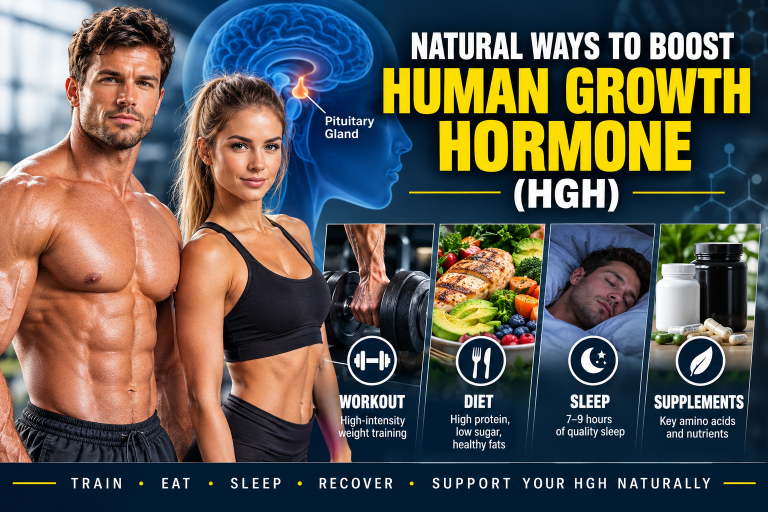
Human growth hormone (HGH) plays an important role in muscle growth, recovery, body composition, bone health and metabolism. While HGH production naturally declines with age, certain lifestyle habits can support your body’s normal growth hormone release.
The good news is that you don’t necessarily need prescription HGH to support healthy growth hormone production. Exercise, quality sleep, nutrition and certain dietary supplements may all influence the natural release of growth hormone.
For anyone interested in building muscle, maintaining a lean physique and recovering from hard workouts, understanding how to naturally support HGH production can be valuable.
In this guide, we’ll look at what human growth hormone is, how to boost growth hormone naturally, the relationship between HGH and exercise, diet and sleep, and the evidence behind HGH-support supplements.
What Is Human Growth Hormone?
Human growth hormone, commonly called HGH or GH, is a hormone produced and released by the pituitary gland.
Growth hormone secretion is pulsatile rather than constant. In other words, your body releases HGH in periodic bursts rather than maintaining one steady level throughout the day.
One of the most important natural HGH pulses occurs during sleep, particularly during slow-wave or deep sleep. Exercise can also be a powerful stimulus for growth hormone secretion.
Growth hormone has several important functions, including supporting:
- Muscle and tissue growth
- Protein metabolism
- Bone health
- Fat metabolism
- Recovery and tissue repair
- Normal body composition
- Production of insulin-like growth factor-1 (IGF-1)
HGH secretion is highest during childhood and puberty and generally declines with age. The pattern and amount of secretion also vary between individuals.
Importantly, more HGH is not automatically better. Growth hormone is one component of a complicated endocrine system, and short-term increases in blood HGH don’t necessarily translate into greater muscle growth or other long-term benefits.
How to Boost Growth Hormone Naturally
If your goal is to support your body’s normal HGH production, focus on the fundamentals first.
The most important strategies include:
- High-intensity exercise
- Progressive resistance training
- Getting adequate deep sleep
- Maintaining a healthy body composition
- Eating a nutritious, protein-rich diet
- Managing excessive sugar and overall calorie intake
- Avoiding chronic sleep deprivation
- Considering certain supplements that may influence GH secretion
Let’s look at each one in more detail.
Human Growth Hormone Workout
Exercise is one of the strongest natural stimuli for growth hormone secretion.
Research summarized by the National Library of Medicine indicates that exercise can stimulate GH release, with high-intensity and anaerobic exercise generally producing a stronger acute GH response than lower-intensity exercise of the same duration.
This is one reason high-intensity resistance training is frequently associated with increases in growth hormone.
High-Intensity Weight Training
For bodybuilders, resistance training can be an excellent way to stimulate the body’s hormonal response to exercise.
A productive HGH-supporting workout should emphasize:
- Large compound exercises
- Multiple muscle groups
- Moderate-to-high training intensity
- Challenging sets
- Relatively controlled rest periods
- Progressive overload
- Sufficient recovery between workouts
Exercises such as squats, deadlifts, rows, presses, pull-ups and other multi-joint movements involve large amounts of muscle mass and can create a substantial training stimulus.
However, don’t make the mistake of believing that you need to turn every workout into an exhausting marathon.
More training is not necessarily better.
A well-designed resistance-training program that provides sufficient stimulus while allowing recovery is generally more useful than simply adding volume in an attempt to produce a larger temporary hormone response.
High-Intensity Training and HGH
High-intensity exercise can cause a temporary increase in circulating growth hormone.
The response can be affected by factors such as:
- Exercise intensity
- Training volume
- Rest intervals
- Age
- Sex
- Fitness level
- Body composition
- Nutritional status
Research indicates that anaerobic exercise can produce a greater acute GH response than aerobic exercise of similar duration.
For bodybuilding purposes, however, the goal shouldn’t simply be to maximize an HGH spike.
Your primary training goals should remain progressive overload, muscular tension, adequate recovery and consistent training.
The hormonal response is only one piece of the muscle-building puzzle.
Human Growth Hormone Diet
Nutrition also influences the environment in which growth hormone is produced.
A good HGH-supporting diet should be based primarily on whole, nutrient-dense foods while providing adequate protein, healthy fats and carbohydrates appropriate for your activity level and goals.
Eat Enough Protein
Protein provides the amino acids required to build and repair muscle tissue.
Good protein sources include:
- Eggs
- Lean beef
- Chicken
- Turkey
- Fish
- Greek yogurt
- Cottage cheese
- Milk
- Whey protein
- Other high-quality protein foods
Protein should be viewed as part of an overall muscle-building nutrition strategy rather than simply an HGH booster.
Limit Excessive Added Sugar
Large amounts of rapidly absorbed carbohydrates and elevated insulin can interact with normal GH secretion.
This doesn’t mean carbohydrates are bad for bodybuilding.
Carbohydrates can provide valuable training fuel, particularly for high-intensity workouts. The bigger concern is consistently consuming excessive amounts of highly processed foods and added sugars while neglecting overall diet quality.
A practical approach is to emphasize:
- Lean protein
- Vegetables
- Fruits
- Whole grains
- Healthy fats
- Minimally processed foods
while keeping highly processed foods and excessive added sugar under control.
Intermittent Fasting and HGH
Fasting can increase growth hormone secretion, and research has established fasting as one of the physiological conditions that can stimulate GH release.
This has led to considerable interest in intermittent fasting as an HGH-boosting strategy.
However, there’s an important distinction:
An increase in circulating HGH during fasting does not automatically mean that intermittent fasting will produce more muscle or better bodybuilding results.
If you are trying to gain muscle, your total calorie and protein intake, training program and recovery still matter enormously.
Intermittent fasting may work well for some people, particularly those trying to control calorie intake, but it isn’t required to support healthy growth hormone production.
Human Growth Hormone and Sleep
If you want to naturally support HGH production, don’t underestimate sleep.
Sleep is one of the most important factors controlling normal growth hormone secretion.
The largest growth hormone pulse of the night is closely associated with the onset of slow-wave sleep.
This is one reason consistently getting enough high-quality sleep is so important for athletes and bodybuilders.
How Much Sleep Do You Need?
For most adults, a practical target is approximately 7 to 9 hours of sleep per night.
But total sleep time isn’t the only consideration.
You should also focus on sleep quality and consistency.
Helpful habits include:
- Go to bed at approximately the same time each night
- Wake up at approximately the same time each morning
- Keep your bedroom dark and quiet
- Limit excessive screen exposure before bed
- Avoid large amounts of caffeine late in the day
- Avoid alcohol close to bedtime
- Keep your bedroom comfortably cool
- Give yourself enough time to sleep
Why Deep Sleep Matters
Growth hormone release is strongly connected to slow-wave sleep.
The first major slow-wave sleep period of the night is particularly important for the large nocturnal GH pulse.
Therefore, consistently sacrificing sleep in order to train longer can be counterproductive.
If you’re serious about bodybuilding, think of sleep as part of your training program.
Train hard. Eat properly. Then recover.
Human Growth Hormone Supplements
There are numerous supplements marketed as “HGH boosters.”
These products generally aren’t the same thing as prescription human growth hormone. Instead, they typically contain amino acids or other ingredients that are proposed to influence the body’s own GH secretion.
Some ingredients that have been studied in relation to growth hormone include:
- L-Arginine
- L-Ornithine
- L-Lysine
- L-Glutamine
- Glycine
- Colostrum
- Ornithine alpha-ketoglutarate (OKG)
L-Arginine
L-arginine is one of the most commonly discussed amino acids when it comes to natural HGH support.
Research indicates that arginine can influence GH secretion under certain circumstances, although results vary depending on the population, dose and whether it is combined with other interventions.I
L-Ornithine
Ornithine has also been studied for its potential effects on growth hormone.
Some research has reported increases in GH when arginine and ornithine are combined, including research involving resistance-trained athletes.
L-Lysine
L-lysine has historically been included in amino-acid combinations marketed for growth hormone support.
L-Glutamine
Glutamine is an abundant amino acid involved in numerous physiological processes.
It has also been investigated for its potential effect on growth hormone. Some research has reported changes in GH after supplementation.
Glycine
Glycine has received attention as a potential sleep and growth-hormone-support ingredient.
Research involving combinations containing glycine and glutamine has reported increases in serum GH in middle-aged and older adults.
Colostrum
Colostrum is the nutrient-rich first milk produced by mammals following birth and contains a variety of proteins and bioactive compounds.
It has been studied in sports nutrition and immune-health research, and some products containing colostrum are marketed for growth-hormone support.
Ornithine Alpha-Ketoglutarate
Ornithine alpha-ketoglutarate, commonly abbreviated OKG, combines ornithine with alpha-ketoglutarate.
It has been investigated in nutritional and clinical settings, and ornithine-related compounds have been studied for possible effects on GH and other metabolic processes.
HGH Factors Human Growth Hormone Support
For people looking for a convenient combination of ingredients traditionally used in HGH-support formulas, HGH Factors from Truly Huge Supplements contains:
- L-Arginine
- L-Ornithine HCl
- L-Lysine HCl
- L-Glutamine
- Colostrum
- Ornithine Alpha-Ketoglutarate
- Glycine
The formula is designed to provide a combination of amino acids and nutritional ingredients commonly associated with natural growth hormone support.
It is important to understand that HGH Factors is a dietary supplement, not prescription human growth hormone, and individual responses can vary.
For the best results, a supplement should complement—not replace—a good training program, proper nutrition and adequate sleep.
The Best Natural HGH-Boosting Strategy
If your goal is to naturally support healthy growth hormone secretion, don’t focus on a single trick.
Instead, combine several fundamentals.
1. Train Hard
Use progressive resistance training and incorporate challenging compound movements. High-intensity exercise is a powerful acute stimulus for GH release.
2. Prioritize Sleep
Aim for approximately 7–9 hours of quality sleep and maintain a consistent sleep schedule.
Deep slow-wave sleep is closely associated with the major nocturnal GH pulse.
3. Eat a High-Quality Diet
Consume sufficient protein and emphasize whole foods while limiting excessive added sugar and highly processed foods.
4. Maintain a Healthy Body Composition
Higher levels of body fat, particularly obesity, are associated with reduced GH secretion.
5. Manage Recovery
Training is the stimulus, but recovery is where your body adapts.
Avoid turning every workout into an all-out endurance event. Give your muscles and nervous system enough time to recover.
6. Consider Supplement Support
Ingredients such as arginine, ornithine and glycine have been studied for their potential effects on GH secretion, but the research is mixed and an acute increase in GH does not necessarily translate into greater muscle growth.
Frequently Asked Questions About Natural HGH
Can you increase human growth hormone naturally?
Yes. Exercise, sleep and certain nutritional conditions can influence natural GH secretion. High-intensity exercise and slow-wave sleep are particularly important physiological stimuli.
What exercise increases HGH the most?
High-intensity exercise, particularly anaerobic and resistance exercise, can produce substantial temporary increases in GH. Exercise intensity, duration, rest periods and individual characteristics all influence the response.
However, there is no single workout that guarantees the highest HGH level for everyone.
Does weight training increase HGH?
Yes. Resistance training can stimulate an acute increase in growth hormone, particularly when the workout is sufficiently intense and involves large amounts of muscle mass.
Does sleep increase HGH?
Yes. Growth hormone secretion is strongly associated with slow-wave sleep, with a major pulse occurring shortly after sleep begins.
Does intermittent fasting increase HGH?
Fasting can increase growth hormone secretion. However, an increase in GH during fasting does not automatically mean that fasting will increase muscle growth or improve bodybuilding results.
What foods increase HGH?
There isn’t a single food that dramatically increases HGH. A balanced diet providing adequate protein and overall nutrition is more important than relying on one particular food.
Do HGH supplements really work?
Some amino acids and nutritional compounds have been shown in certain studies to influence GH secretion, but the evidence is mixed. Some controlled studies have found little or no consistent response to amino-acid combinations.
Consequently, HGH supplements should not be viewed as equivalent to prescription HGH.
Is HGH the same as testosterone?
No. HGH and testosterone are different hormones with different functions.
Growth hormone is produced primarily by the pituitary gland, while testosterone is primarily produced by the testes in men and the ovaries and adrenal glands in women.
Both hormones are involved in physiology relevant to muscle and body composition, but they should not be confused with one another.
Final Thoughts on Naturally Increasing HGH
Human growth hormone is an important part of the body’s natural growth, repair and metabolic processes.
While there are numerous products and strategies marketed as HGH boosters, the fundamentals remain the most important place to start.
Train intensely. Eat well. Maintain a healthy body composition. Get enough sleep. Recover properly.
High-intensity exercise can stimulate GH release, while deep slow-wave sleep provides one of the body’s most important natural opportunities for growth hormone secretion.
Certain amino acids—including arginine, ornithine and glycine—have also been investigated for their ability to influence GH secretion, although the evidence is mixed and should be interpreted realistically.
For individuals interested in nutritional support, a combination formula such as HGH Factors can provide several of these commonly studied ingredients in one supplement.
Most importantly, remember that the goal shouldn’t simply be to chase a higher HGH number. The bigger goal is to create the training, nutrition and recovery environment that allows your body to function and adapt at its best.
Natural HGH support starts with the basics—and consistency is what makes those basics work.
Shop Truly Huge Bodybuilding Supplements
Email support@trulyhugebodybuilding.com or call (800) 635-8970 with any questions you have and we’ll be happy to help you find the best supplements for your bodybuilding and fitness goals.