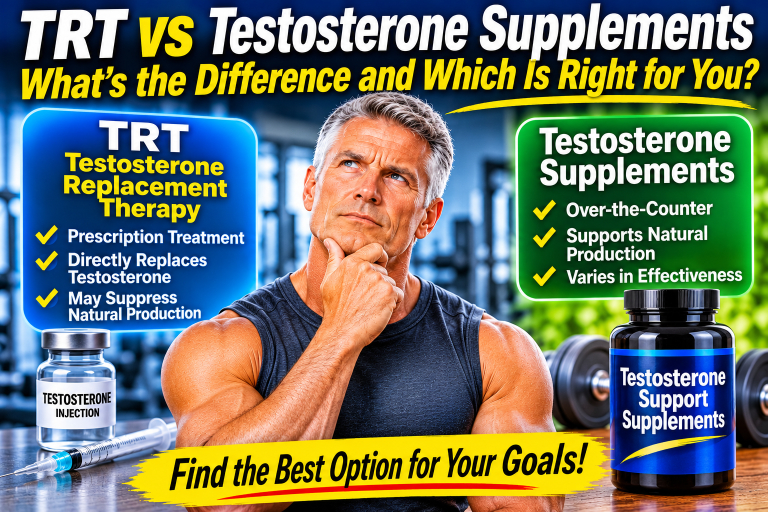
TRT vs testosterone supplements is a topic that more and more men are researching, especially as they get older and begin noticing changes in their energy, strength, muscle mass, sex drive, and overall well-being.
Should you consider testosterone replacement therapy (TRT), or would you be better off trying natural testosterone booster supplements?
There is a big difference between these two approaches. TRT is a medical treatment that replaces testosterone your body is not producing in sufficient amounts, while natural testosterone support supplements are designed to help support your body’s own hormone production.
In this article, I’ll explain the differences between TRT and testosterone supplements, discuss the signs of low testosterone, and share some of the things I’ve personally done to maintain healthy testosterone levels as I’ve gotten older.
I’ll also discuss some of the ingredients commonly found in testosterone support supplements and share information about our Truly Huge Supplements Andro-Shock formula.
A quick disclaimer: I’m not a doctor, and this article is not medical advice. I’m sharing my personal opinions, experience, and general information to help you better understand your options. You should always consult your own healthcare provider before beginning testosterone therapy or taking supplements, particularly if you have an existing medical condition or take prescription medications.
What Is a Normal Testosterone Level for Men?
Testosterone is the primary male sex hormone. It plays an important role in muscle development, bone density, red blood cell production, libido, energy, and many other bodily functions.
Testosterone levels are generally highest during early adulthood and tend to decline gradually as men get older. However, the rate of decline varies considerably from one man to another.
For adult men, a commonly used total testosterone reference range is approximately:
- 300–1,000 ng/dL: A commonly used reference range.
- Below 300 ng/dL: A level that may indicate testosterone deficiency when accompanied by appropriate symptoms.
- Above 1,000 ng/dL: Above the upper end of many commonly used reference ranges.
Keep in mind that reference ranges vary between laboratories, and a testosterone number by itself doesn’t tell the whole story.
According to American Urological Association guidelines, a total testosterone level below 300 ng/dL is a reasonable cutoff for supporting a diagnosis of testosterone deficiency. However, doctors generally require symptoms and at least two separate early-morning testosterone tests to establish the diagnosis.
In other words, don’t automatically assume you have low testosterone because you feel tired or aren’t building muscle like you used to. Get your levels checked and discuss the results with your doctor.
Signs of Low Testosterone in Men
Testosterone affects many different aspects of men’s health. When levels become too low, you may begin noticing changes in how you feel and perform.
Some common signs and symptoms include:
Sexual and Reproductive Symptoms
- Reduced sex drive or libido.
- Fewer spontaneous or morning erections.
- Erectile difficulties.
- Reduced fertility.
Physical Symptoms
- Loss of muscle mass and strength.
- Increased body fat, particularly around the waist.
- Reduced exercise performance.
- Decreased bone density.
- Fatigue and low energy.
Mental and Emotional Symptoms
- Mood changes or irritability.
- Difficulty concentrating.
- Reduced motivation.
- Depressed mood.
- Problems with memory and mental clarity.
It’s important to understand that these symptoms aren’t exclusive to low testosterone. Poor sleep, stress, depression, obesity, certain medications, and other medical conditions can produce similar symptoms.
If you’re experiencing several of these problems, talk with your healthcare provider about whether testosterone testing is appropriate.
What Is the Difference Between TRT and Testosterone Supplements?
Although both approaches are associated with testosterone, they work very differently.
What Is Testosterone Replacement Therapy (TRT)?
Testosterone replacement therapy is a medical treatment prescribed to men who have clinically diagnosed testosterone deficiency.
TRT supplies testosterone directly to the body using medically prescribed preparations.
Common forms include:
- Testosterone injections.
- Testosterone gels.
- Testosterone patches.
- Certain oral testosterone medications.
- Other prescription formulations.
The purpose of TRT is to restore testosterone levels to an appropriate range and help improve symptoms associated with confirmed testosterone deficiency.
For men who genuinely have hypogonadism, TRT can be an effective treatment.
However, there are important considerations before starting.
TRT can suppress your body’s natural testosterone production.
When you introduce testosterone from an external source, your brain generally reduces the hormonal signals that tell your testicles to produce testosterone. This involves suppression of luteinizing hormone (LH) and follicle-stimulating hormone (FSH).
As a result, natural testosterone production can decrease substantially, and sperm production can also be reduced.
This is one of the biggest considerations when deciding whether TRT is right for you.
If you discontinue TRT, your natural testosterone production may take time to recover. Recovery varies depending on factors such as age, treatment duration, dosage, and the underlying cause of testosterone deficiency. In some men, recovery may be incomplete.
However, it isn’t accurate to say that everyone who starts TRT will permanently shut down natural testosterone production or necessarily need treatment for the rest of their life.
The important thing is to understand the potential consequences before beginning treatment.
TRT also requires medical supervision and ongoing monitoring. Your doctor may monitor testosterone levels, blood counts, blood pressure, and prostate health as appropriate.
If you’re considering having children, discuss fertility before starting TRT. External testosterone can significantly reduce sperm production.
What Are Natural Testosterone Booster Supplements?
Testosterone booster supplements are over-the-counter products containing combinations of herbs, vitamins, minerals, and other ingredients intended to support healthy testosterone production.
Unlike TRT, these products do not supply prescription testosterone directly.
Instead, certain ingredients may help support normal hormonal function, particularly when someone has a nutritional deficiency or another factor that can be improved.
Common ingredients found in testosterone support supplements include:
- Tribulus Terrestris.
- Longjack (Eurycoma longifolia).
- Horny Goat Weed.
- Magnesium.
- Zinc.
- Vitamin D.
- Other herbal extracts.
One advantage of natural testosterone support supplements is that they don’t intentionally replace your body’s testosterone with an external hormone.
However, that doesn’t mean they’re guaranteed to increase testosterone levels.
Research on testosterone booster supplements is mixed. Some ingredients have limited promising evidence, while many popular ingredients have not consistently demonstrated meaningful increases in testosterone in clinical studies.
They also cannot replace TRT when a man has medically confirmed testosterone deficiency requiring treatment.
TRT vs Testosterone Supplements: Which Is Better?
There isn’t one answer that applies to every man. It depends on your testosterone levels, symptoms, overall health, and personal goals.
Here is a quick comparison:
| Feature | TRT | Testosterone Supplements |
|---|---|---|
| What they do | Replace testosterone | Aim to support natural hormone production |
| Prescription required | Yes | Generally no |
| Directly supplies testosterone | Yes | No |
| Suppresses natural production | Generally yes | Not intended to |
| Fertility considerations | Can significantly reduce sperm production | Depends on ingredients; not a fertility treatment |
| Effectiveness | Established for diagnosed testosterone deficiency | Varies by ingredient and individual |
| Medical monitoring | Required | Important when appropriate |
| Best suited for | Men with confirmed hypogonadism | Men seeking nutritional and lifestyle support |
When Should You Consider TRT?
If you have consistently low testosterone levels and symptoms associated with testosterone deficiency, TRT may be an appropriate medical treatment.
A qualified healthcare provider can investigate why your testosterone is low and discuss the potential benefits, risks, and alternatives.
Don’t let fear of TRT prevent you from getting necessary treatment if you genuinely have a medical deficiency.
When Might Testosterone Support Supplements Be Worth Considering?
If your testosterone levels are within a healthy range but you’re interested in supporting normal hormonal function, you may want to investigate lifestyle improvements and appropriately formulated supplements.
However, don’t expect an over-the-counter testosterone booster to turn a testosterone level of 250 into 800.
Supplements are not a substitute for medical treatment, and their effectiveness depends heavily on the ingredients, dosages, and individual circumstances.
How to Increase Testosterone Naturally
Now I’d like to share some of the things I’ve personally done to maintain healthy testosterone levels as I’ve gotten older.
I’m 64 years old, and my total testosterone level is around 600 ng/dL naturally.
I attribute my results to maintaining an active lifestyle, following a good diet, getting enough sleep, and using certain supplements.
I can’t say that any one of these things is responsible for my testosterone level, but I believe that consistently taking care of your body makes a difference.
Here are some of the things I recommend paying attention to.
1. Testosterone and Exercise
Resistance training is one of the best things you can do to maintain muscle mass, strength, and overall health as you age.
I personally perform three days per week of high-intensity weight training.
I believe in training hard, but I also believe in allowing your body sufficient time to recover.
One of the biggest mistakes I see people make is overtraining. They spend too much time in the gym, train too frequently, and don’t give their bodies enough time to recover.
My approach is to use challenging workouts, focus on progressive overload, and allow adequate recovery between sessions.
Weight training can produce temporary increases in testosterone, but don’t confuse those short-term changes with a guaranteed long-term increase in resting testosterone levels.
The bigger benefit is maintaining muscle, strength, metabolic health, and physical performance as you get older.
2. Testosterone and Diet
Your diet plays an important role in maintaining normal hormone production.
I follow a high-protein diet with healthy fats and a moderate amount of carbohydrates.
Some of the foods I include are:
- Eggs.
- Lean beef.
- Chicken and turkey.
- Fish.
- Greek yogurt.
- Nuts and seeds.
- Olive oil.
- Vegetables and fruits.
- Whole grains.
Protein is especially important as we get older because maintaining muscle mass becomes increasingly important.
Healthy fats also provide essential fatty acids and support normal bodily functions.
I try to keep junk food, excessive sugar, and alcohol consumption to a minimum.
You don’t need an extreme diet to support healthy testosterone levels. Consistency and good overall nutrition are much more important.
3. Testosterone and Sleep
Sleep is one of the most overlooked factors when it comes to maintaining healthy testosterone levels.
I try to get between 7 and 9 hours of quality sleep every night.
Your body performs many important recovery and hormonal functions while you’re sleeping. Consistently getting too little sleep can negatively affect testosterone levels, energy, recovery, and workout performance.
Here are a few things that can help improve sleep:
- Maintain a consistent bedtime.
- Keep your bedroom cool and dark.
- Avoid excessive caffeine late in the day.
- Limit screen time before bed.
- Avoid heavy meals and excessive alcohol close to bedtime.
- Get regular exercise.
If you snore heavily or experience excessive daytime sleepiness, talk with your doctor about possible sleep apnea.
4. Testosterone and Supplements
Along with exercise, diet, and sleep, I’ve experimented with various supplements over the years.
Some of the ingredients commonly used in testosterone support formulas include Tribulus Terrestris, Longjack, Horny Goat Weed, and Chrysin.
Let’s take a closer look.
Tribulus Terrestris
Tribulus Terrestris is a popular herbal ingredient found in many testosterone support products.
It has traditionally been used to support male vitality and libido.
Longjack (Eurycoma Longifolia)
Longjack, also known as Tongkat Ali, is a traditional herbal ingredient used in male vitality supplements.
Some preliminary research suggests it may help support testosterone levels in certain populations, particularly men with lower testosterone.
However, the evidence is still developing, and results are not guaranteed.
Horny Goat Weed
Horny Goat Weed is an herb traditionally used to support male sexual health and vitality.
Its active compound, icariin, has attracted interest because of its biological activity.
Chrysin
Chrysin is a naturally occurring flavonoid found in certain plants and foods.
It is sometimes included in testosterone support formulas because of laboratory research involving aromatase, an enzyme involved in converting testosterone into estrogen.
The bottom line is that these ingredients are not equivalent to prescription testosterone, and the research supporting them varies considerably.
Truly Huge Supplements Andro-Shock Testosterone Support Formula
Over the years, I’ve experimented with many different supplements and ingredients intended to support male health, strength, and muscle development.
I eventually combined several of these ingredients into our Truly Huge Supplements Andro-Shock formula.
Andro-Shock is an all-in-one testosterone support supplement stack containing a combination of herbal extracts and minerals.
Andro-Shock Supplement Facts
The formula includes:
| Ingredient | Amount |
|---|---|
| Tribulus Terrestris | 750 mg |
| Magnesium Oxide | 200 mg |
| Chrysin | 75 mg |
| Horny Goat Weed | 50 mg |
| Longjack | 50 mg |
| Saw Palmetto Berries | 50 mg |
| Hawthorn Berries | 50 mg |
| Cissus Quadrangularis | 50 mg |
Why consider Andro-Shock?
Andro-Shock provides several commonly used ingredients in one convenient formula for men interested in nutritional support for male vitality and an active lifestyle.
It is an over-the-counter supplement, not prescription testosterone, and it should not be considered a treatment for hypogonadism.
Individual responses to supplements vary, and the ingredient amounts listed above do not establish that the formula will increase testosterone or produce muscle gains.
If you take prescription medications or have a medical condition, check with your healthcare provider or pharmacist before using a multi-ingredient supplement.
Learn more about Truly Huge Supplements Andro-Shock
Andro-Shock Customer Experiences and Success Stories
Over the years, I’ve received feedback from customers who have used Andro-Shock as part of their training and supplement programs.
Here are three examples of customer experiences.
These are individual customer testimonials, not controlled clinical studies. Their experiences cannot establish that Andro-Shock increases testosterone or that other users will achieve similar results.
Customer Testimonial: John Harris
“I have been working out for almost 4 years and I have tried everything: creatine, protein shakes, and a lot of other supplements; but nothing has compared to Andro Shock. I was at first skeptical if Andro Shock was as good as I had heard.
And I have to tell you; I have seen tremendous gains in the gym. From using Andro Shock, the effects that I noticed were fast muscle gains and increased libido. I gained 15 lbs on my bench press in 4 weeks, and I had a greater sense of well being.
My libido was outstanding and my confidence grew a lot. It has given me everything I expected and more. I will definitely buy more Andro Shock in the future.”
Sincerely,
John Harris
Customer Testimonial: George H. Barrigher
“I gained 9 lbs. of real muscle. I would also like to make it clear about some of the benefits of increased testosterone for me:
- I sleep more per night.
- Super libido.
- More alert.
- Restored memory.
This list could go on and on. Thanks Paul.”
Your loyal patron,
George H. Barrigher
Customer Testimonial: Daniel Conner
“I did a complete 30 days using no other supplements besides protein and what I found was that Andro-Shock does work and works well.
My first few days of using it I noticed an increase in my sex drive. After the 2nd week I noticed gains in strength and muscle stamina and endurance which is perfect for a Strongman.
With me getting stronger from using the Andro-Shock I put on some solid muscle as well. I am anxious to use both Andro-Shock and Nitrobol together for my next study.”
Thanks a ton,
Daniel Conner
My Final Thoughts: TRT vs Testosterone Boosters
So, which is better: TRT or natural testosterone support supplements?
My opinion is that you shouldn’t automatically jump into testosterone replacement therapy without first understanding your testosterone levels, investigating possible underlying causes, and discussing your options with a qualified healthcare provider.
TRT can be an excellent medical treatment for men who genuinely have testosterone deficiency. However, it is a significant commitment that requires medical supervision, monitoring, and consideration of fertility.
Natural testosterone support supplements offer a different approach. They are intended to support normal bodily functions rather than replace the testosterone your body produces.
However, don’t expect supplements to work miracles. Some ingredients have promising research, while others have little convincing evidence that they significantly increase testosterone.
Personally, at 64 years old, I believe that staying active, lifting weights, eating right, getting adequate sleep, and maintaining a healthy body composition are some of the best things men can do to support their health as they age.
If you’re experiencing symptoms of low testosterone, get tested rather than guessing.
And if your levels are healthy and you’re looking for additional nutritional support, learn about the ingredients in testosterone support supplements and choose your products carefully.
You don’t have to stop training hard, building muscle, and taking care of yourself just because you’re getting older!
Frequently Asked Questions About TRT vs Testosterone Supplements
1. Is TRT better than natural testosterone boosters?
TRT is generally more effective for treating medically diagnosed testosterone deficiency because it directly replaces testosterone. Natural testosterone boosters have variable evidence and cannot reliably correct clinically low testosterone.
2. Can testosterone supplements increase testosterone naturally?
Some ingredients may support normal testosterone production in certain circumstances, particularly when nutritional deficiencies or other correctable factors are involved. However, most over-the-counter testosterone boosters have not consistently demonstrated meaningful increases in testosterone.
3. Does TRT shut down natural testosterone production?
External testosterone suppresses the hormonal signals that stimulate natural testosterone production. This can substantially reduce the body’s own production and sperm production. Recovery after discontinuation varies, and some men may experience prolonged or incomplete recovery.
4. Can you increase testosterone naturally after age 60?
Yes, it is possible to maintain healthy testosterone levels after age 60. Regular resistance training, adequate sleep, proper nutrition, maintaining a healthy body weight, and addressing underlying health problems can all support overall hormonal health.
5. What is a good testosterone level for a 60-year-old man?
There is no separate universally accepted testosterone target for every 60-year-old man. A commonly used adult male reference range is approximately 300–1,000 ng/dL, although laboratory ranges vary. Symptoms, free testosterone when appropriate, and individual health circumstances also matter.
6. Can you take testosterone boosters while on TRT?
Don’t assume that combining testosterone boosters with TRT will improve results. There is limited evidence that doing so provides additional benefits, and some supplements may interact with medications or affect health. Discuss all supplements with your prescribing physician.
7. Do testosterone boosters work as well as TRT?
No. Testosterone boosters do not work like prescription testosterone. TRT directly supplies testosterone, while supplements attempt to support normal bodily processes. They should not be considered interchangeable treatments.
8. Should I get my testosterone levels checked before taking a testosterone booster?
If you’re experiencing symptoms associated with low testosterone, getting evaluated is a sensible first step. Your doctor can determine whether testing is appropriate and interpret the results. A supplement should never be used as a substitute for diagnosing a possible hormone deficiency.
Shop Truly Huge Bodybuilding Supplements
Email support@trulyhugebodybuilding.com or call (800) 635-8970 with any questions you have and we’ll be happy to help you find the best supplements to help you reach your bodybuilding and fitness goals.