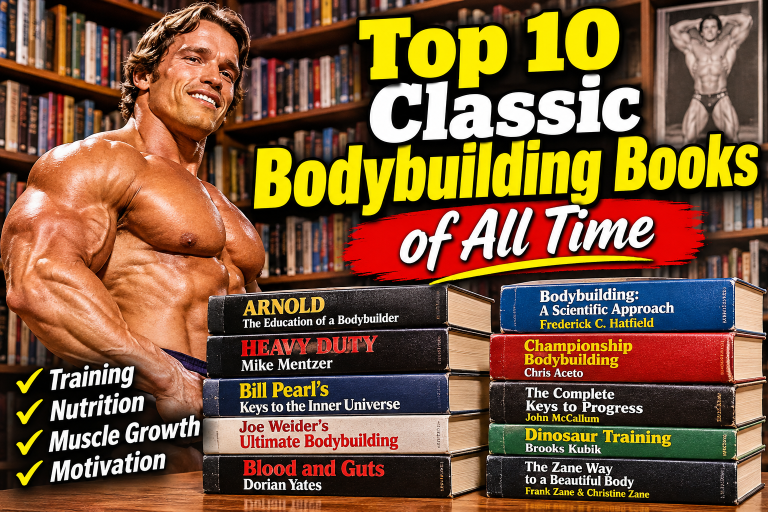
If you are serious about building muscle, increasing strength, and learning the science and art of bodybuilding, there is a lot you can learn from the classic bodybuilding books.
I’ve been weight training for 48 years, and over that time, I’ve read almost every bodybuilding book ever written. Some books provided valuable training information, others taught me about nutrition and exercise science, and a few completely changed the way I approached bodybuilding.
The following are ten of my favorite classic bodybuilding books. These are not just books about lifting weights. They are packed with training knowledge, nutritional advice, bodybuilding history, and motivation. Whether you are a beginner just starting your bodybuilding journey or an experienced lifter looking to take your physique to another level, I believe these books are worth reading.
I’ve included my personal reviews and opinions about each book, including what I liked, what I learned, and who I think would benefit most from reading them.
You can find many of these classic bodybuilding books on eBay
1. Arnold: The Education of a Bodybuilder by Arnold Schwarzenegger
One of the most inspirational bodybuilding books ever written.
Arnold: The Education of a Bodybuilder was the first bodybuilding book I ever read, and it remains one of my favorites.
The book covers Arnold Schwarzenegger’s journey from his early beginnings in Austria to becoming one of the greatest bodybuilders of all time. It combines his personal bodybuilding biography with information about weight training, exercise selection, nutrition, and developing a champion’s mindset.
What makes this book particularly enjoyable is Arnold’s enthusiasm and passion for bodybuilding. His story demonstrates what can be accomplished through hard work, dedication, consistency, and an unwavering commitment to achieving your goals.
The training information is also interesting, with plenty of exercises, workout routines, and bodybuilding techniques.
However, I do have one criticism. Arnold’s training routines involve extremely high training volumes, with numerous exercises and sets for each muscle group. While this approach obviously worked for Arnold, I believe it is too much volume for most recreational bodybuilders.
In my opinion, following this type of high-volume training without the recovery capacity, genetics, and experience of an elite professional bodybuilder can lead to excessive fatigue and inadequate recovery.
My verdict: An absolute must-read for inspiration and bodybuilding history. Even if you don’t agree with all the training recommendations, Arnold’s enthusiasm for bodybuilding is contagious.
Best for: Beginners, bodybuilding enthusiasts, and anyone who wants to learn about the golden era of bodybuilding.
2. Heavy Duty: A Logical Approach to Muscle Building by Mike Mentzer
The book that completely changed the way I train.
Heavy Duty: A Logical Approach to Muscle Building by Mike Mentzer is probably the most influential bodybuilding book I’ve ever read.
Before discovering this book, I was following more traditional bodybuilding routines involving multiple exercises and numerous sets for each muscle group.
Mentzer introduced me to High Intensity Training (HIT), a completely different approach to building muscle.
His philosophy was based on brief, infrequent, high-intensity workouts. Rather than performing endless sets, Mentzer believed that a relatively small amount of properly performed, high-intensity exercise could stimulate muscle growth.
His approach emphasized several important principles:
- Train with maximum effort and intensity.
- Focus on progressive overload.
- Perform exercises with strict form and controlled movements.
- Take sets to momentary muscular failure when appropriate.
- Allow adequate recovery between workouts.
- Avoid unnecessary training volume.
What really appealed to me was the logic behind his arguments. Instead of simply accepting that more sets and more training must produce more muscle, Mentzer encouraged readers to question traditional bodybuilding practices.
His ideas made so much sense to me that they changed the way I approached bodybuilding from that point forward.
I eventually had the opportunity to be personally trained by Mike Mentzer, which gave me an even greater appreciation for his training philosophy.
Although I don’t necessarily agree with every detail of his recommendations, I believe his emphasis on training intensity, recovery, and avoiding unnecessary volume is extremely valuable.
My verdict: If I could recommend only one bodybuilding training book, this would be it. It challenges conventional thinking and encourages you to train smarter rather than simply spending more time in the gym.
Best for: Intermediate and advanced bodybuilders, HIT enthusiasts, and anyone interested in a different approach to muscle growth.
3. Bill Pearl’s Keys to the Inner Universe by Bill Pearl
One of the most comprehensive bodybuilding exercise encyclopedias ever written.
Bill Pearl’s Keys to the Inner Universe is an incredible reference book for anyone interested in bodybuilding exercises.
Bill Pearl was one of the legendary bodybuilders of the golden era, winning the Mr. Universe title multiple times. His knowledge of bodybuilding and exercise selection is reflected throughout this enormous training reference.
What makes this book special is the sheer number of exercises it covers.
It includes exercises for virtually every major muscle group, along with different variations and explanations of how to target specific areas of the body.
Whether you are looking for exercises for your chest, back, shoulders, arms, legs, or abdominals, you will find plenty of options.
I especially like this book as a reference guide. Rather than simply providing a workout routine, it gives you an extensive collection of exercises that can help you design and modify your own training programs.
It is particularly useful when you want to introduce new exercises into your routine or find alternatives to movements that may not be working well for you.
My verdict: An excellent bodybuilding reference book that belongs in the library of anyone serious about weight training.
Best for: Beginners, personal trainers, experienced bodybuilders, and anyone interested in learning more about exercise selection.
4. Joe Weider’s Ultimate Bodybuilding: The Master Blaster’s Principles of Training and Nutrition by Joe Weider
A detailed look at the Weider system of bodybuilding.
Joe Weider’s Ultimate Bodybuilding is one of Joe Weider’s best-known books and provides an extensive explanation of his approach to bodybuilding training and nutrition.
Joe Weider was one of the most influential figures in bodybuilding history. Along with his brother Ben Weider, he helped popularize bodybuilding around the world and played an important role in developing competitive bodybuilding.
This book covers the Weider training principles, which include a variety of techniques designed to stimulate muscle growth.
Some of these principles include:
- Progressive overload
- The split-system training approach
- Supersets
- Forced repetitions
- Drop sets
- Pre-exhaustion
- Rest-pause training
- Peak contraction
- Muscle confusion
One of the things I particularly like about this book is the article on Rest-Pause training by Mike Mentzer.
Rest-pause is a technique that allows you to extend a set beyond the point where you would normally stop by taking brief pauses between repetitions. It can be an effective way to increase training intensity when used appropriately.
Although I generally favor a lower-volume, higher-intensity approach to bodybuilding, I appreciate many of the principles discussed in this book.
It also provides an interesting historical look at how bodybuilding training evolved during the golden era.
My verdict: A valuable bodybuilding resource filled with different training techniques. You don’t have to follow every Weider principle to benefit from understanding them.
Best for: Bodybuilders who want to learn different training techniques and experiment with workout programming.
5. Blood and Guts: The Ultimate Approach to Building Maximum Muscle Mass by Dorian Yates
A brutally intense approach to building muscle.
Blood and Guts by six-time Mr. Olympia Dorian Yates is another outstanding bodybuilding training book.
Dorian Yates revolutionized professional bodybuilding with his massive muscular development and his approach to high-intensity training.
His training philosophy shared similarities with Mike Mentzer’s Heavy Duty system. Rather than performing extremely high volumes of training, Yates emphasized relatively brief workouts with very intense working sets.
His approach involved:
- High-intensity working sets.
- Strict exercise execution.
- Progressive resistance.
- Training to muscular failure.
- Adequate rest and recovery.
- A strong emphasis on nutrition and consistency.
One of the most interesting aspects of this book is getting an inside look at how one of the greatest bodybuilders in history approached his training.
Yates was known for his incredible work ethic and ability to push himself through extremely demanding workouts.
His approach demonstrates that building muscle isn’t necessarily about spending hours in the gym. Training quality, effort, exercise selection, and recovery all matter.
However, I would caution beginners against immediately trying to duplicate Dorian’s workouts. His training methods were developed through years of experience, and the intensity he used requires excellent exercise technique and an understanding of recovery.
My verdict: One of the best bodybuilding books for anyone interested in high-intensity training. If you enjoyed Mike Mentzer’s Heavy Duty philosophy, you will appreciate Dorian Yates’ approach.
Best for: Intermediate and advanced bodybuilders, HIT enthusiasts, and fans of old-school bodybuilding.
6. Bodybuilding: A Scientific Approach by Frederick C. Hatfield
A bodybuilding book that combines training experience with exercise science.
Bodybuilding: A Scientific Approach by Frederick C. Hatfield, better known as Dr. Squat, is one of the more educational bodybuilding books in my collection.
Hatfield was an accomplished powerlifter, exercise scientist, and strength-training authority. His background gave him a different perspective on bodybuilding compared to some of the more traditional bodybuilding authors.
The book covers virtually every aspect of bodybuilding, including:
- Muscle physiology.
- Exercise selection.
- Training intensity.
- Training volume.
- Different repetition ranges.
- Nutrition.
- Supplementation.
- Workout programming.
One of my favorite parts of this book is the model training program that incorporates high, medium, and low repetitions.
The idea is to use different repetition ranges to provide a variety of training stimuli.
For example, lower repetitions allow you to use heavier weights and emphasize strength development, while moderate and higher repetitions provide different muscular demands.
The book also discusses different components of muscle development, including the contractile elements and sarcoplasmic components of muscle tissue.
I particularly like this approach because it recognizes that bodybuilding is more complicated than simply lifting the heaviest weight possible or performing endless repetitions.
My verdict: An excellent educational resource for anyone who wants to understand the science behind bodybuilding and develop a more comprehensive training program.
Best for: Intermediate and advanced bodybuilders, strength enthusiasts, and readers interested in exercise physiology.
7. Championship Bodybuilding by Chris Aceto
An excellent resource for anyone interested in competitive bodybuilding.
Championship Bodybuilding: Chris Aceto’s Instruction Book for Bodybuilding is a valuable bodybuilding resource written by one of the sport’s respected coaches.
Chris Aceto has worked with numerous competitive bodybuilders and is particularly well known for his knowledge of contest preparation, nutrition, and physique development.
Unlike some bodybuilding books that focus almost exclusively on workout routines, this book takes a broader approach to developing a competitive physique.
It covers subjects such as:
- Bodybuilding training.
- Nutrition for muscle growth.
- Fat loss and contest preparation.
- Developing muscular proportions.
- Body composition.
- Competition preparation.
What I particularly like about this book is its practical approach to bodybuilding.
Building an impressive physique requires more than just lifting weights. You also need to understand nutrition, recovery, body composition, and how to make adjustments as your physique develops.
If you are interested in competing in bodybuilding, this book provides valuable information about what it takes to prepare for the stage.
Even if you have no intention of competing, there is plenty of useful information for anyone interested in improving their physique.
My verdict: One of the better bodybuilding books for understanding the competitive side of the sport, especially nutrition and contest preparation.
Best for: Competitive bodybuilders, physique athletes, and serious trainees interested in nutrition and body composition.
8. The Complete Keys to Progress by John McCallum
Old-school bodybuilding wisdom presented in an entertaining way.
The Complete Keys to Progress by John McCallum is one of the most entertaining bodybuilding books you will ever read.
Originally published as a collection of articles, the book brings together McCallum’s training advice and bodybuilding philosophy in a series of entertaining stories.
What makes this book different is the way the information is presented.
Instead of reading a dry technical manual, you get practical training advice through stories involving interesting characters, weightlifting challenges, and old-school gym experiences.
The book covers a variety of topics, including:
- Building muscular size and strength.
- Basic barbell exercises.
- Progressive overload.
- Eating for muscle growth.
- Developing overall physical strength.
- Improving your training performance.
McCallum believed in hard work, basic exercises, and consistent progression.
His approach emphasized building a foundation of strength through movements such as squats, deadlifts, presses, and other fundamental exercises.
I especially enjoy the entertaining writing style. It makes the information easy to absorb while keeping you motivated to get into the gym and train.
Some of the recommendations reflect an earlier era of bodybuilding, but the underlying principles of hard work, consistency, and progressive overload remain relevant.
My verdict: One of the most enjoyable bodybuilding books I’ve read. It combines practical training advice with humor and motivation.
Best for: Old-school bodybuilding fans, beginners, and anyone who enjoys learning through entertaining stories.
9. Dinosaur Training: Lost Secrets of Strength and Development by Brooks Kubik
A return to old-school strength and muscle building.
Dinosaur Training by Brooks Kubik is a great book for anyone interested in traditional strength training and old-school bodybuilding methods.
The book takes readers back to an era when strength athletes relied on basic exercises, heavy weights, hard work, and simple training equipment.
Kubik discusses the training methods used by old-time strongmen and weightlifters, emphasizing the importance of developing genuine strength rather than simply chasing a pump.
Some of the central themes include:
- Heavy basic exercises.
- Progressive strength development.
- Barbell and dumbbell training.
- Grip strength.
- Physical toughness.
- Consistency and dedication.
- Simple but demanding workout routines.
I like this book because it reminds readers that you don’t need an elaborate collection of machines or complicated training techniques to build an impressive physique.
There is tremendous value in mastering the basic exercises and gradually increasing the amount of weight you can lift.
Although Dinosaur Training is more strength-oriented than a traditional bodybuilding manual, many of its principles can be applied to building muscle.
It is also a refreshing change from modern fitness trends that sometimes place too much emphasis on complicated workouts and unnecessary training equipment.
My verdict: A fantastic book for anyone who appreciates old-school training and wants to build serious strength and muscular development.
Best for: Strength enthusiasts, hardgainers, powerlifters, and bodybuilders who appreciate traditional training methods.
10. The Zane Way to a Beautiful Body Through Weight Training for Men and Women by Frank Zane and Christine Zane
A balanced approach to building an aesthetic physique.
The Zane Way to a Beautiful Body by Frank Zane and Christine Zane offers a different perspective on bodybuilding compared to the high-volume training of Arnold Schwarzenegger or the low-volume, high-intensity approach of Mike Mentzer.
Frank Zane, a three-time Mr. Olympia, was famous for his incredible proportions, symmetry, muscular definition, and aesthetic physique.
His approach to bodybuilding was more moderate in terms of training volume and intensity, combining resistance training with an emphasis on developing a balanced and proportionate physique.
The book discusses training for both men and women and provides information about exercise selection, workout routines, and developing an attractive, muscular body.
One of the things I appreciate about Zane’s approach is that bodybuilding isn’t just about getting as big as possible.
Muscular balance, symmetry, proportion, and conditioning are also important aspects of developing an impressive physique.
His training philosophy offers something of a middle ground between Arnold’s extremely high-volume training and Mentzer’s low-volume, high-intensity approach.
My verdict: A great bodybuilding book for anyone interested in developing a balanced, symmetrical, and aesthetically pleasing physique.
Best for: Men and women interested in bodybuilding, physique development, symmetry, and proportion.
Which Classic Bodybuilding Book Should You Read First?
With so many excellent bodybuilding books available, choosing where to start can be difficult.
My recommendation is to choose a book based on what you want to accomplish.
Here are my suggestions:
| Your Goal | Recommended Book |
|---|---|
| Bodybuilding inspiration | Arnold: The Education of a Bodybuilder |
| High-intensity training | Heavy Duty |
| Learning exercises | Keys to the Inner Universe |
| Learning training techniques | Joe Weider’s Ultimate Bodybuilding |
| High-intensity muscle building | Blood and Guts |
| Understanding exercise science | Bodybuilding: A Scientific Approach |
| Competitive bodybuilding | Championship Bodybuilding |
| Old-school bodybuilding | The Complete Keys to Progress |
| Building strength and size | Dinosaur Training |
| Developing an aesthetic physique | The Zane Way |
What I Learned From 48 Years of Bodybuilding
After 48 years of training and reading just about every bodybuilding book I could get my hands on, I’ve come to appreciate that there is no single perfect way to build muscle.
Different bodybuilders have achieved incredible results using different training philosophies.
Arnold Schwarzenegger favored high-volume training. Mike Mentzer advocated brief, high-intensity workouts with plenty of recovery. Dorian Yates developed his own version of high-intensity training, while Frank Zane focused on symmetry, proportion, and aesthetics.
Frederick Hatfield approached bodybuilding from a more scientific perspective, while John McCallum and Brooks Kubik emphasized traditional strength-building methods.
What can we learn from all these different approaches?
1. Progressive overload is essential.
If you want to build muscle, you need to provide your muscles with a reason to grow. Over time, this means improving your training performance through increased resistance, additional repetitions, or better exercise execution.
2. Training intensity matters.
Simply going through the motions isn’t enough. You need to challenge your muscles with sufficiently demanding exercise.
3. Recovery is just as important as training.
Muscle growth is an adaptive process that requires adequate recovery. More training isn’t automatically better, and excessive volume can interfere with recovery and progress.
4. Nutrition makes a difference.
You need sufficient calories, protein, carbohydrates, fats, vitamins, and minerals to support muscle growth and recovery.
5. Consistency wins in the long run.
You don’t build an impressive physique in a few weeks. It takes years of consistent training, proper nutrition, and dedication.
My advice is to learn from different bodybuilding experts, experiment with different training approaches, and determine what works best for your individual needs and recovery capacity.
Don’t blindly follow someone else’s workout routine just because they built an incredible physique using it.
Frequently Asked Questions About Classic Bodybuilding Books
What is the best bodybuilding book of all time?
In my opinion, Mike Mentzer’s Heavy Duty: A Logical Approach to Muscle Building is one of the best bodybuilding training books ever written. It changed the way I approached training and introduced me to high-intensity training. However, Arnold Schwarzenegger’s The Education of a Bodybuilder is another outstanding choice for inspiration and bodybuilding knowledge.
What are the best bodybuilding books for beginners?
Beginners should consider Arnold Schwarzenegger’s The Education of a Bodybuilder for motivation and Bill Pearl’s Keys to the Inner Universe for learning exercises. Both provide valuable information for someone starting their bodybuilding journey.
What bodybuilding books explain high-intensity training?
Mike Mentzer’s Heavy Duty and Dorian Yates’ Blood and Guts are two excellent books for learning about high-intensity bodybuilding training. Both emphasize hard working sets, progressive overload, and adequate recovery.
Are old-school bodybuilding books still relevant?
Absolutely. While exercise science and nutritional research have advanced over the years, many fundamental bodybuilding principles remain the same. Progressive overload, proper exercise technique, sufficient protein intake, and adequate recovery are still important for building muscle.
What is the best bodybuilding book for building muscle and strength?
For strength and muscular development, I recommend Brooks Kubik’s Dinosaur Training and Frederick Hatfield’s Bodybuilding: A Scientific Approach. Both provide valuable information about resistance training, strength development, and building muscle.
Final Thoughts: Learn From the Bodybuilding Legends
One of the best investments you can make in your bodybuilding journey is educating yourself.
The ten books I’ve reviewed here represent different training philosophies, experiences, and approaches to developing a muscular physique. Some emphasize high volume, others high intensity, and some focus more on strength, nutrition, or aesthetics.
After 48 years of bodybuilding, I still believe there is plenty to learn from the legends who helped shape this sport.
You don’t have to agree with everything an author recommends. Take the information that makes sense, put it into practice, and evaluate your results.
If I could offer one final piece of advice, it would be this: Don’t just read about bodybuilding. Apply what you learn in the gym.
About the Author
Paul Becker is the owner of Truly Huge Bodybuilding Supplements, a competitive natural bodybuilder, personal trainer, and bodybuilding author. With 48 years of weight-training experience, Paul has studied numerous bodybuilding training systems and has personally trained with Mike Mentzer and Casey Viator. His passion is helping bodybuilders of all experience levels build muscle, improve strength, and achieve their physique goals.
Visit Truly Huge Bodybuilding for bodybuilding workouts, nutrition advice, supplement information, and tips to help you build a bigger, stronger physique.